
A 2026 LEADERSHIP PERSPECTIVE ON WHY PREDICTABILITY—NOT GROWTH—SEPARATES RESILIENT ENTERPRISES FROM REACTIVE ONES
Cash generates options. It enables leadership teams to invest ahead of the market, absorb external shocks, renegotiate from strength, and act decisively when competitors hesitate. Revenue growth tells a story of momentum, but cash flow determines whether that story can continue.
Despite modern FP&A platforms, rolling forecasts, and advanced analytics tooling, many enterprises still struggle to explain why cash positions fluctuate so dramatically. Quarter-end reviews often devolve into reconciliation debates instead of forward-looking decisions. The result is hesitation, delayed investments, and excess financial buffers that quietly erode returns.
Long-standing research referenced by global banks and restructuring firms consistently shows that poor cash flow management is one of the leading contributors to business failure—even among companies that appear profitable on paper. Profit validates strategy. Cash validates execution.
In a 2026 operating environment shaped by sustained interest rate pressure, structurally unstable supply chains, and customers demanding flexibility in how and when they pay, cash flow predictability is no longer a treasury problem.
It is a strategic capability that directly influences valuation, resilience, and competitive speed.
THE CORE PROBLEM: CASH IS A TIME SERIES, BUT YOUR BUSINESS OPERATES AS A NETWORK
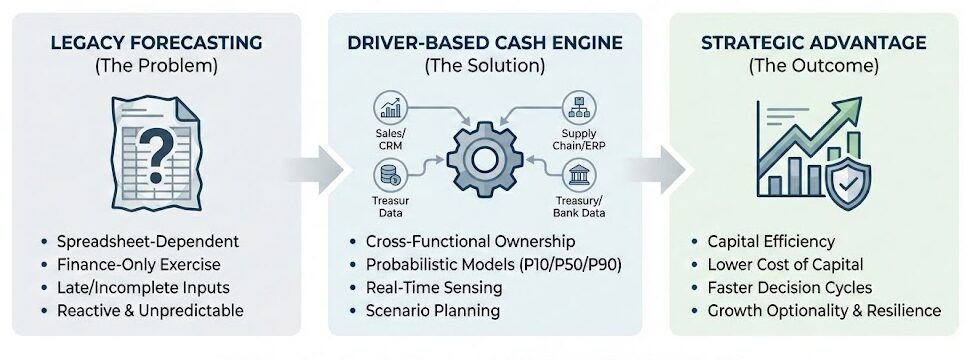
Cash forecasting breaks down when it is treated as a finance-only exercise. In reality, cash is the downstream result of hundreds of interconnected operational decisions made daily across Sales, Procurement, Manufacturing, Logistics, and Customer Success.
When these functions operate with misaligned assumptions, cash becomes noisy, reactive, and difficult to trust. Forecasts fail not because finance teams lack effort or skill, but because the operating model itself is fragmented.
Structural Pain Points That Undermine Predictability:
- Spreadsheet fragility:
Forecasting models built on manually maintained spreadsheets often contain hidden logic errors, inconsistent assumptions, and stale inputs. As businesses scale in complexity, these models become impossible to govern and break the moment conditions change.
- Information latency:
Signals that materially impact cash—missed delivery milestones, billing errors, invoice disputes, or shifts in customer payment behavior—are typically detected weeks after they occur. By the time they appear in finance reports, the cash impact has already happened.
- Risk concentration:
In most organizations, a small group of customers or suppliers drives a disproportionate share of cash timing volatility. Without counterparty-level modeling, these exposures are treated as surprises rather than manageable risks.
- Superficial scenario planning:
Adjusting revenue assumptions up or down fails to capture real-world disruptions such as port congestion, supplier insolvency, regulatory delays, or customers unilaterally extending payment terms. These are operational events with direct cash consequences. - Quantifiable Business Consequences:
- Superficial scenario planning:
Low predictability forces organizations to carry excess liquidity as insurance. Many firms maintain cash buffers 20–30 percent higher than structurally required, tying up capital that could otherwise fund innovation, acquisitions, or market expansion.
Uncertainty also increases the cost of capital. Inconsistent cash forecasts weaken lender confidence, reduce negotiating leverage, and increase reliance on short-term credit facilities with higher interest rates.
Operationally, teams become reactive. Expedite fees rise, invoice disputes linger, and leadership discussions focus on explaining variances rather than executing strategy. Over time, this erodes confidence, slows decision-making, and diminishes organizational velocity.
WHAT HIGH-PERFORMING ORGANIZATIONS DO DIFFERENTLY
High-performing organizations do not attempt to improve predictability by forecasting harder. They change the model entirely.
They treat cash as an operational KPI with shared ownership and move from static, point-in-time forecasts to driver-based, probabilistic intelligence.
- From revenue timing to invoice realism
Sales forecasts are reconciled with contractual billing terms, milestone structures, invoicing accuracy, and historical customer payment behavior. Weighted DSO replaces generic averages. - From inventory as cost to inventory as a cash lever
Inventory decisions are evaluated based on how quickly stock converts into cash, using SKU-level and location-level signals to balance service levels against working capital exposure. - From uniform policies to risk-weighted execution
Customers are segmented by payment reliability, concentration risk, and strategic importance, allowing teams to focus effort where it materially improves cash outcomes. - From single-number forecasts to probability ranges
Instead of committing to one “best guess,” organizations model P10, P50, and P90 outcomes, giving leadership confidence intervals rather than false precision.
- From revenue timing to invoice realism
FIVE TRENDS RESHAPING CASH FLOW PREDICTABILITY IN 2026
Operational data is increasingly outperforming general ledger summaries as a predictor of cash timing. CRM stage changes, collections notes, dispute codes, and shipping signals often forecast cash movement weeks before financial postings.
Commercial terms have become a competitive lever. Subscription pricing, usage-based billing, and extended payment terms are now standard expectations and must be evaluated at the deal desk—not reconciled after the fact.
Supply chain variability is no longer an exception. Lead times fluctuate due to geopolitical risk, weather disruptions, and capacity constraints, requiring dynamic logistics assumptions in cash forecasts.
AI-driven forecasting is gaining adoption, but only where data governance is strong. Machine learning models amplify insight only when master data is clean, consistent, and trusted.
Organizational boundaries around cash are dissolving. Treasury, FP&A, and operating leadership increasingly operate in a unified cadence, often described as a single cash office or working capital council.

A PRACTICAL PLAYBOOK FOR BUILDING CASH PREDICTABILITY
- Phase 1: Establish a shared source of truth
Core flows such as Order-to-Cash, Procure-to-Pay, and Forecast-to-Fulfill are mapped and consolidated into a unified dataset trusted by both finance and operations. - Phase 2: Introduce driver-based forecasting
Accounts receivable models incorporate payer-level histories and dispute patterns, while accounts payable forecasts reflect supplier calendars, payment runs, and early-pay programs. - Phase 3: Add real-time sensing
Signals such as purchase order reschedules, invoice rejections, credit holds, and shipment delays feed a weekly control view that highlights emerging variance before it impacts cash. - Phase 4: Institutionalize scenario planning
Commercial, operational, and supply-side disruptions are pre-modelled with defined response playbooks, reducing reaction time when events occur. - Phase 5: Align incentives
Shared KPIs around predictability, working capital velocity, and forecast bias reinforce cross-functional ownership and accountability.
- Phase 1: Establish a shared source of truth
HIGH-IMPACT ACTIONS LEADERS CAN TAKE THIS QUARTER
Require terms-aware deal reviews where every non-standard payment term explicitly quantifies its impact on the median cash position.
Develop a payer health score that blends quantitative payment data with qualitative relationship insight to prioritize collection efforts.
Reduce invoice dispute cycles by enforcing a 48–72 hour resolution SLA to eliminate hidden DSO inflation.
Publicly measure forecast accuracy by function. When accuracy is visible, precision improves.
TECHNOLOGY THAT ACTUALLY MOVES THE NEEDLE
- Success does not require replacing core ERP systems. In 2026, the differentiator is the integration layer.
- Leading organizations unify CRM platforms with ERP, logistics, and warehouse data, delivering role-specific views for treasury, sales operations, and supply chain leaders.
- For large customer timing risk, probabilistic techniques such as Monte Carlo simulation provide realistic cash distributions rather than deterministic assumptions.
- Adoption matters more than features. A well-governed solution used consistently outperforms a sophisticated platform that teams do not trust.
HOW CRESCO INTERNATIONAL HELPS
- Cresco International helps organizations turn cash into a managed capability by aligning data, decisions, and discipline.
- Engagements typically begin with a rapid diagnostic that identifies the top working capital levers and benchmarks cash conversion cycle variability.
- This is followed by a driver-based build phase, where unified datasets and role-specific dashboards are deployed.
- Clients commonly achieve a 20–40 percent improvement in forecast accuracy and a five-to-fifteen-day reduction in cash conversion cycle within two quarters.
CONCLUSION: PREDICTABILITY BEFORE GROWTH
Growth without cash predictability is a gamble. Predictability transforms growth into a compounding advantage.
If teams are still debating whose numbers are correct instead of acting on shared insight, the problem is not ambition—it is architecture.
Organizations that invest in cash predictability now will enter 2026 with more optionality, faster execution, and a measurable advantage over competitors still reacting to last month’s variance.
Cash does not follow strategy. Strategy follows cash.