
INTRODUCTION:
In many boardrooms today, the conversation is no longer about whether to invest in “space,” advanced platforms, or mission-critical launches. The real question is far more uncomfortable:
How quickly can the organization move from intent to ignition—without exploding cost, risk, or credibility?
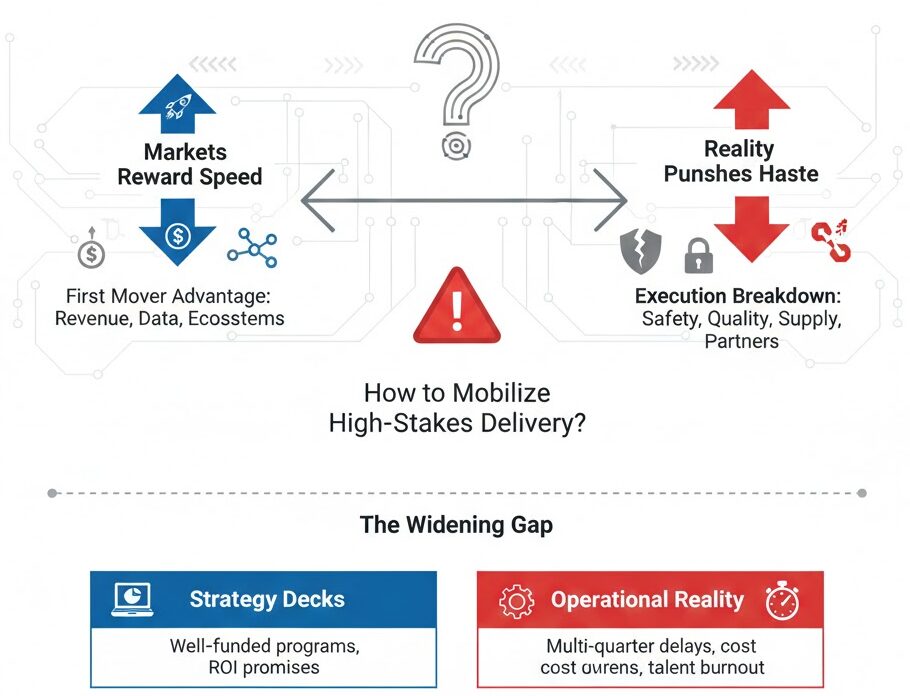
Leaders feel pressure from two opposing forces:
- Markets reward speed. First movers capture new revenue pools, data advantages, ecosystem positioning, and customer mindshare.
- Reality punishes haste. Safety, quality, compliance, supply volatility, and partner dependencies make “move fast” an expensive slogan when execution breaks down.
This is why the question “How long does it take to launch space?” matters far beyond rockets. It has become shorthand for a broader executive challenge:
How long does it take to mobilize a complex enterprise to deliver something high-stakes, cross-functional, and technically unforgiving—without losing control of value?
For many organizations—especially in manufacturing, engineering-led enterprises, and IT & digital services providers—this challenge shows up as:
- Multi-quarter delays despite well-funded transformation programs
- Program spend rising faster than clarity on ROI
- Talent burnout in the teams doing the hardest integration work
- A widening gap between strategy decks and operational reality
This blog reframes the issue in business terms:
Launch velocity is not a calendar estimate. It is an enterprise capability.
THE CORE PROBLEM & BUSINESS IMPACT
Why “Launch” Takes Longer Than Leaders Expect
- Across space programs and space-adjacent initiatives—satellite-enabled services, advanced manufacturing, launch supply chains, mission operations, ground systems, and data commercialization—timelines stretch for reasons that are organizational, not purely technical.
- Launch Is Treated as a Project, not a System
Deadlines, budgets, and PMOs are assigned, with the assumption that execution will naturally follow.
In reality, launch is a tightly coupled system of dependencies:
- Design maturity
- Qualification and certification
- Supply continuity
- Software and data readiness
- Test windows and regulatory gates
- Partner interfaces and operational handover
When one element slips, the entire system absorbs the shock.
- Decision Latency Becomes the Hidden Critical Path
- Trade-offs—speed vs. redundancy, build vs. buy, cost vs. reliability—are repeatedly escalated.
Each escalation adds days or weeks. Across dozens of decisions, governance quietly becomes the longest path on the schedule.
- Trade-offs—speed vs. redundancy, build vs. buy, cost vs. reliability—are repeatedly escalated.
- Quality and Risk Are Addressed Too Late
- When quality, compliance, and risk teams act as final inspectors instead of early design partners, defects travel downstream—where change is most expensive.
- Late rework does not just delay launch; it multiplies cost and erodes confidence.
- Telemetry Is Noisy—and Often Optimistic
- Many programs track activity (hours burned, tickets closed, milestones hit) rather than readiness (integration stability, test confidence, operational resilience).
- Leadership dashboards stay green while teams feel the system is fragile.
- Capacity Exists; Capability Does Not
Enterprises can add people quickly. What they cannot scale easily is:
- Systems integration discipline
- Reliability engineering mindset
- Interface management rigor
- Operational rehearsal capability
Adding people without capability increases coordination cost—and defect density.
What’s Really at Stake
1. Financial Impact (CFO Lens)
- Delays extend cash burn while pushing revenue realization further out
- Capital accumulates behind optimistic assumptions that are repeatedly re-baselined
- Vanity metrics replace the real question: When does value begin—and how durable will it be?
2.Operational Drag (COO Lens)
- Missed launch dates cascade into rescheduled tests, disrupted suppliers, staffing churn, and coordination fatigue
- Firefighting replaces structured execution
3.Talent & Culture Strain (CHRO Lens)
- Permanent “crunch mode” becomes normalized
- High performers leave due to chaos, not challenge
- Trust erodes across engineering, procurement, operations, and leadership
4.Competitive Disadvantage (CEO / Strategy Lens)
- Competitors launch, learn, iterate, and build credibility
- The enterprise becomes known for announcements rather than outcomes
Time-to-launch is not just time. It is risk accumulation.
WHAT HAS FUNDAMENTALLY CHANGED
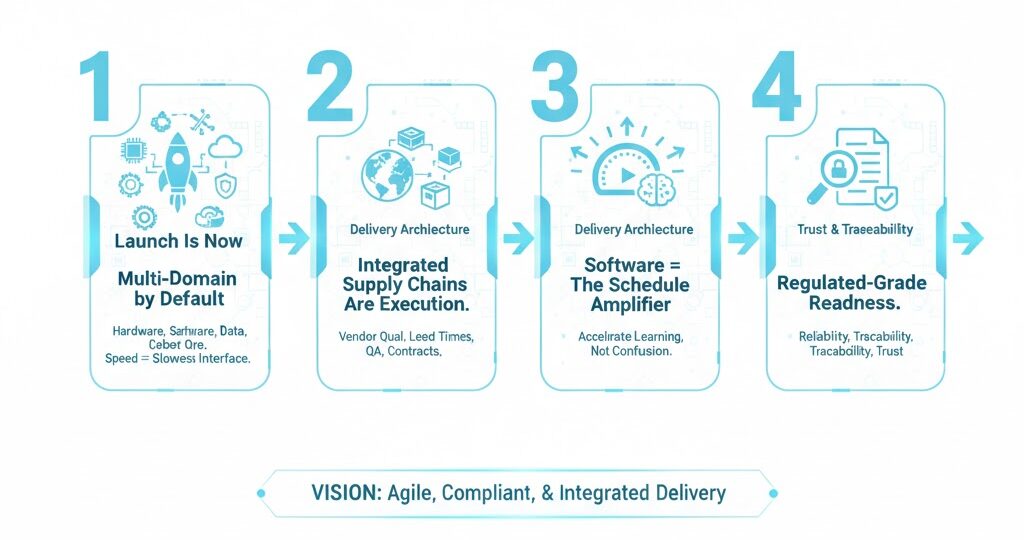
- Launch Is Now Multi-Domain by Default
Modern initiatives blend hardware, software, data, cybersecurity, mission operations, and partner ecosystems.
The timeline is dictated by the slowest interface—technical or organizational.
- Supply Chains Are Part of the Execution Model
Vendor qualification, component lead times, QA maturity, and contracting structures now directly shape delivery speed.
Contracting is no longer procurement. It is delivery architecture.
- Software Is a Schedule Amplifier
Software can accelerate learning—or amplify confusion—depending on whether the organization is designed to absorb rapid feedback.
- “Regulated-Grade” Expectations Are Spreading
Even outside formal regulation, customer trust and reputational risk demand reliability, traceability, and operational readiness from day one.
WHY TRADITIONAL APPROACHES FAIL
The classic sequence—define, build, test, fix, launch—assumes:
- Stable requirements
- Predictable interfaces
- Manageable late rework
- Readiness proven at the end
Under modern complexity, this model breaks.
Readiness must be earned continuously, not declared late.
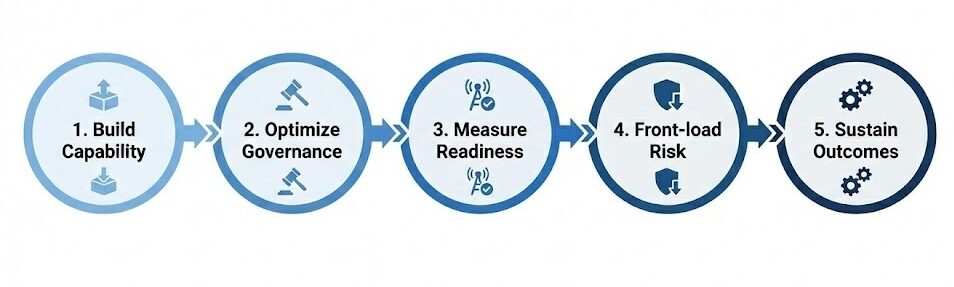
THE LAUNCH VELOCITY BLUEPRINT (LVB)
A 5-Step Framework for Speed with Control
1) Define Launch as a Business Capability
Launch must include:
- Technical readiness
- Operational run readiness
- Commercial clarity
Misaligned definitions turn every milestone into a negotiation.
2) Design Governance to Eliminate Decision Latency
- Clear decision owners
- Time-boxed escalation paths
- Explicit “go / no-go” criteria
Speed comes from decision architecture, not more meetings.
3) Replace Activity Metrics with Readiness Signals
Track what actually predicts launch success:
- Integration stability trends
- Early vs. late defect discovery
- Interface maturity
- Operational rehearsal completion
Truth early beats optimism late.
4) Engineer Quality and Risk Upfront
- Design for testability and recovery
- Remove single points of failure early
- Rehearse failure scenarios before launch
This reduces cost, delay, and burnout simultaneously.
5) Harden the Operating Model Before Launch
- Clear build-to-run ownership
- Incident response standards
- Vendor rhythms aligned to operations
- Structured post-launch learning
A launch without an operating model is a liability.
A PRACTICAL 30-60-90 DAY ROADMAP
First 30 Days
- Define true launch outcomes
- Map real critical paths and decision bottlenecks
- Identify top five schedule killers
- Introduce readiness-based reporting
Days 31–60
- Implement decision architecture
- Rebuild plans around integration and rehearsal
- Front-load risk removal
- Uplift critical capabilities
Days 61–90
- Run end-to-end integration rehearsal
- Stabilize runbooks and monitoring
- Align partners to readiness checkpoints
- Lock a sustainable execution cadence
Outcome: Faster progress, fewer surprises, less drama.
HOW CRESCO INTERNATIONAL ENABLES LAUNCH VELOCITY
Cresco International works where most transformations fail: execution mechanics.
Typical engagement focus areas include:
- Decision and governance architecture that reduces latency
- Readiness-based performance management
- Operating model alignment across build and run
- Capability injection at critical moments (integration, reliability, delivery leadership)
- GCC and distributed delivery enablement that operates as one system
The objective is not more consulting—it is a repeatable launch capability.
EXECUTIVE TAKEAWAYS
- Time-to-launch is an enterprise capability, not a project estimate
- Decision latency is often the real critical path
- Readiness signals outperform activity metrics
- Early risk removal saves time, money, and talent
- Durable outcomes require operational readiness—not just launch optics
CONCLUSION
“How long it takes to launch” is rarely determined by engineering effort alone. In complex enterprises, it is set by how quickly leaders can:
- Create alignment
- Remove ambiguity
- Accelerate decisions
- Establish truthful visibility into readiness
Organizations that launch faster are not reckless—they are disciplined.
And the same capability that accelerates launch velocity improves every high-stakes initiative that follows: transformations, platform modernizations, shared services, and global operating model shifts.
CALL TO ACTION
If your organization is navigating a high-stakes launch—space-related or simply mission-critical in complexity—Cresco International can help you identify the real critical path, redesign execution for readiness, and build a repeatable capability to deliver faster with confidence.
If you want a focused discussion on what must change in the next 90 days to materially improve launch velocity, Cresco is ready to engage—grounded in execution, aligned to outcomes, and built for speed-to-value.