
WHY TRANSFORMATIONS STALL WHEN LEADERS FUND THE WRONG THINGS
Transformation rarely fails because the strategy was wrong.
It fails because the organization funded the strategy with the wrong logic.
Across global enterprises—especially in manufacturing and BFSI—leaders are under mounting pressure. Margins are tightening. Customer expectations keep rising. Risk and compliance demands don’t slow down. Talent remains scarce.
Yet, every planning cycle still produces the same conversation:
- “We can approve the platform upgrade.”
- “We can’t commit to the operating budget to change how work actually happens.”
- “We’ll automate—once the business signs off on the capital request.”
- “We’ll stabilize operations—after the transformation program is complete.”
This is the OPEX VS CAPEX thinking problem—an accounting distinction that has quietly become a strategic constraint.
When transformation is treated as a CapEx event—something you buy and amortize—organizations unintentionally starve the OpEx required to make transformation real:
new roles, new controls, new decision rights, sustained training, process discipline, and ongoing data and product stewardship.
The outcome is predictable:
- Programs stall
- Benefits weaken
- Fragility increases
- Leaders conclude, “Transformation doesn’t work here.”
This is no longer theoretical.
For many enterprises, the choice is now binary:
Redesign and fund the operating model—or accept slower execution, higher risk, and a widening competitive gap.
THE CORE PROBLEM
When CapEx Funds “Change” but OpEx Still Runs the Business
At its core, the OpEx–CapEx trap isn’t about finance. It’s about how leadership signals what truly matters.
What’s really happening
CapEx is perceived as:
- Easier to approve for large initiatives
- Cleaner to justify with project-style business cases
- More visible to governance forums
- Politically safer because it’s time-bound
OpEx is often seen as:
- A permanent cost increase
- Harder to defend without immediate ROI
- Vulnerable during quarterly cost reviews
- A signal of inefficiency if headcount rises
This bias creates a systemic pattern:
over-investment in assets (systems, tools, infrastructure) and under-investment in capabilities (skills, ownership, governance, control design, and adoption).
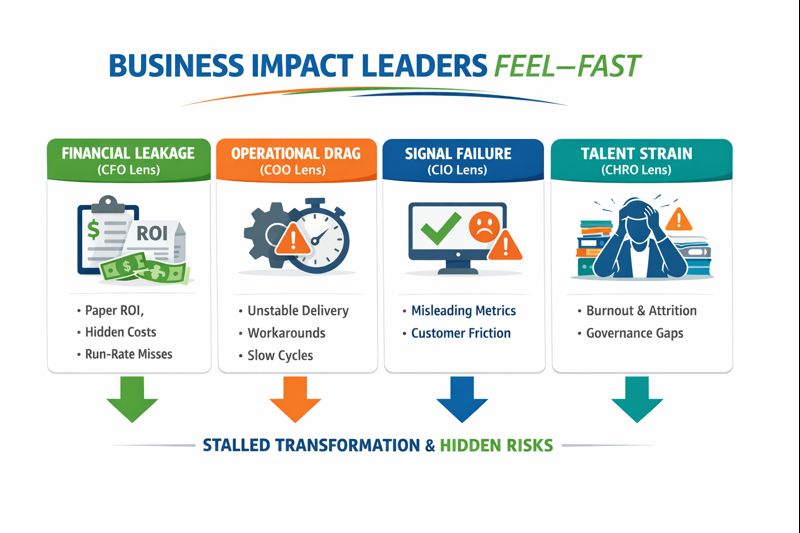
BUSINESS IMPACT LEADERS FEEL—FAST
- Financial leakage (CFO lens)
CapEx-heavy transformations generate paper ROI that depends on behaviours no one funded. Savings appear in models but don’t materialize in run-rate results. Meanwhile, hidden OpEx accumulates through contractors, rework, and workaround-heavy operations—just without transparency.
- Operational drag (COO lens)
Delivery becomes unstable. Exceptions multiply. Cycle times grow. Teams spend more time coordinating workarounds than executing standard work.
- Signal failure (CIO lens)
Dashboards show green system health while customers experience friction. Telemetry tracks uptime—not process health—forcing operations teams to absorb gaps manually.
- Talent strain (CHRO lens)
High performers become shock absorbers: fixing issues, training others, and filling governance gaps. Burnout rises. Equity erodes. Attrition risk spikes—exactly where continuity matters most.
THE HIDDEN COST OF INACTION
The most expensive outcome isn’t delay.
It’s compound complexity:
- Tech debt grows as exceptions are coded instead of eliminated
- Controls weaken, increasing audit and risk exposure
- Processes diverge across regions, eroding scale benefits
- Leadership bandwidth is consumed by operational noise
The enterprise keeps paying—just in quieter, less visible ways.
WHY TRADITIONAL TRANSFORMATION MODELS FAIL
Three structural shifts punish CapEx-only thinking.
1) Work is cross-functional by default
Order-to-cash. Plan-to-produce. Onboarding-to-servicing. Claims-to-resolution.
These value streams span functions, systems, and controls. Tools alone cannot fix cross-functional work. They require OpEx-funded ownership, governance, and operating cadence.
2) Digital is no longer a project
Enterprises have moved from projects to products, from releases to continuous change. That demands persistent capacity—product management, data stewardship, process excellence, and change enablement. Treat these as temporary costs and the organization loses its execution muscle.
3) Risk and trust requirements intensified
Especially in BFSI—and increasingly in regulated manufacturing—leaders must prove control, not just performance. Transparency, accountability, and data lineage are operating capabilities, not one-time installations.
COMMON ENTERPRISE FAILURE PATTERNS
- The tool-first trap: buying capability instead of building it
- ROI theatre: benefits modelled without funded adoption
- Contractor dependency loops: temporary capacity becomes permanent OpEx
- Governance vacuums: unclear decision rights slow execution
- Measurement mismatch: activity metrics replace outcome metrics
None of these come from poor intent. They come from a flawed mental model: transformation is capital; operations are cost.
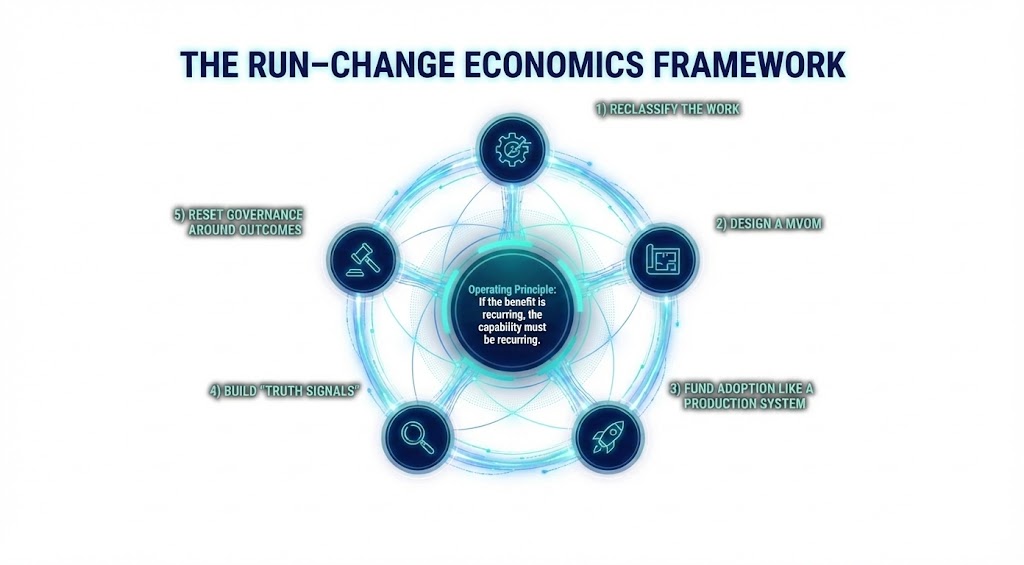
THE RUN–CHANGE ECONOMICS FRAMEWORK
Funding Transformation the Way Value Is Actually Created Operating principle: If the benefit is recurring, the capability must be recurring.
Five Leadership Moves
1) Reclassify the Work
- Separate asset builds (platforms, infrastructure) from capability runs (ownership, governance, training, data stewardship).
- If benefits depend on OpEx but funding doesn’t reflect that, the plan isn’t credible.
2) Design a Minimum Viable Operating Model (MVOM)
Not an ideal future state—but the smallest model that reliably delivers outcomes:
- End-to-end ownership
- Clear decision rights
- Fast issue-resolution cadence
- Standard work and control points
- Outcome-based measurement
3) Fund Adoption Like a Production System
Adoption isn’t communication—it’s operating design:
- Role redesign and capacity planning
- Coaching, not one-time training
- Incentives aligned to new behaviours
- Frontline feedback loops
- Transitional support without permanent shadow operations
4) Build “Truth Signals”
Replace vanity dashboards with metrics that can’t be gamed:
- First-time-right
- Exception volume and root causes
- Manual touchpoints
- End-to-end cycle time
- Control effectiveness
- Customer friction indicators
5) Reset Governance Around Outcomes
Governance is a decision system, not a reporting forum:
- One accountable owner per outcome
- Time-bound escalation paths
- Explicit trade-off rules
- Stop-start-continue discipline
- Transparent resourcing rules
A REALISTIC 30–60–90 DAY ROADMAP
Days 1–30: Diagnose & Reframe
- Identify 3–5 stuck value streams
- Quantify benefits dependent on behavior change
- Map recurring capability gaps
- Align leadership on truth signals
Days 31–60: Build the MVOM
- Assign end-to-end owners
- Establish operating cadence
- Define standard work and controls
- Rebalance OpEx toward adoption and capability
Days 61–90: Pilot & Scale
- Run one value stream end-to-end
- Eliminate top exception drivers
- Lock role and capacity changes
- Publish a sequenced scale plan
The goal isn’t perfection—it’s credible momentum.
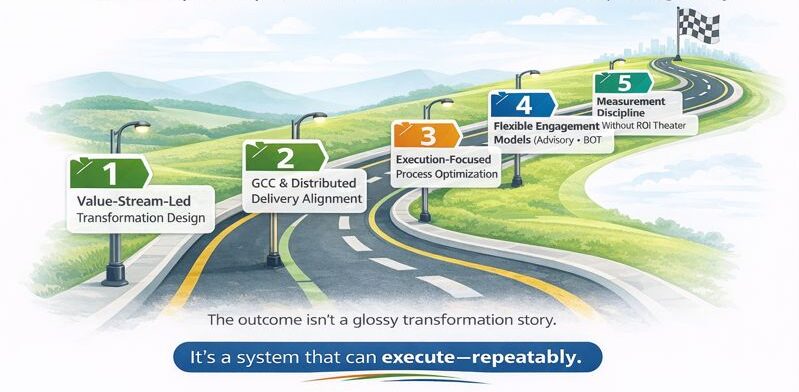
HOW CRESCO INTERNATIONAL ENABLES EXECUTION
Cresco helps enterprises move from investment intent to operating reality:
- Value-stream-led transformation design
- GCC and distributed delivery alignment
- Execution-focused process optimization
- Flexible engagement models (advisory, BOT, managed services)
- Measurement discipline without ROI theater
The outcome isn’t a glossy transformation story. It’s a system that can execute—repeatably.
EXECUTIVE TAKEAWAYS
- Recurring benefits demand recurring capabilities
- CapEx buys assets; OpEx builds muscle
- Adoption is an operating design problem
- Truth signals beat dashboards
- Governance must enable decisions, not delay them
FINAL THOUGHT: STOP FINANCING TRANSFORMATION LIKE A ONE-TIME EVENT
Accounting distinctions will always matter. But treating OpEx as “cost” and CapEx as “strategy” is increasingly dangerous.
The organizations that win aren’t the ones that spend more.
They’re the ones that fund what makes outcomes repeatable: ownership, governance, workforce enablement, and reliable measurement.
Approve capital without funding the operating model—and you institutionalize fragility.
Reframe transformation as run–change economics, and you unlock speed, resilience, and scale—without burning out your best people.
CALL TO ACTION: START WITH A 90-DAY REALITY CHECK
If your transformation outcomes aren’t matching the investment, Cresco International can help identify where OpEx–CapEx thinking is limiting execution—and design a practical operating model that converts spend into durable run-rate results.
Sometimes, one focused strategic conversation is enough to reset the trajectory.