
INTRODUCTION: The Lease Decision Has Moved from Facilities to the Boardroom
For many executives, lease discussions still begin with square footage, location, and cost per seat. In today’s environment, that framing is not just incomplete—it’s risky.
Across global BFSI and IT services organizations, leaders are facing a sharper tension:
- The business needs operational stability to run regulated, client-critical work
- The operating model demands flexibility as demand, talent availability, and regulatory expectations shift faster than planning cycles
Traditional leases promise control—until they lock the organization into a footprint misaligned with delivery reality.
Flex leases promise agility—until variability starts eroding governance, security, and culture.
What follows is a pattern now familiar in executive forums:
- Growth and productivity targets are committed at the board level
- Workforce models evolve quarter by quarter
- Real estate decisions lag—creating operational debt that surfaces later as margin pressure, delivery risk, and talent attrition
This is not a facilities issue.
It is a capital allocation, execution resilience, and operating model risk issue.
THE CORE PROBLEM: WHEN SPACE DECISIONS LAG OPERATING REALITY
Why This Problem Exists (And Why It’s Getting Worse)
Most enterprises are making lease decisions based on assumptions that no longer hold:
- Forecast certainty is structurally lower – Demand volatility, client concentration, regulatory shifts, and technology change have compressed planning horizons from years to quarters.
- Work is distributed—but unevenly – Not all roles can move fluidly. Secure operations, regulated processing, and high-collaboration teams have fundamentally different space needs.
- Transformation creates non-linear demand – Automation, platform migrations, and operating model redesigns create temporary overlaps, dual-running periods, and surge requirements—not smooth reductions.
- Governance has not evolved at the same pace – Few organizations have a cross-functional mechanism tying space decisions to talent plans, delivery risk, and technology readiness.
In practice, leaders are not choosing between flex and traditional leases.
They are choosing—often implicitly—between different forms of operational risk.
BUSINESS IMPACT BY FUNCTION: WHERE THE PAIN SHOWS UP
CFO VIEW: The Roi Question That Arrives Too Late The CFO challenge is not whether flex is “cheaper per seat.”
The real question is whether the portfolio delivers defendable ROI across scenarios.
Common failure modes include:
- Optimizing headline lease costs while ignoring churn, relocation, downtime, and vendor fragmentation
- Underestimating second-order costs: fit-outs, reinstatement, duplicate technology, transition support
- Treating occupancy as a static expense instead of a lever tied to revenue capacity and risk exposure
Typical outcome: Organizations carry a high fixed-cost footprint and an unmanaged flex overlay—paying twice for uncertainty.
COO VIEW: Execution Drag Disguised as Delivery Issues
For operations leaders, the wrong lease structure becomes an invisible execution tax:
- Inconsistent team rhythms and onboarding experiences
- Delivery centers unable to scale fast enough during ramp-ups
- Fragmented standards that complicate quality assurance and training
- Increased coordination overhead across landlords and service providers
Flex without discipline introduces variability. Traditional without adaptability creates bottlenecks.
CHRO VIEW: Talent Signals That Don’t Show Up in Models
Lease decisions quietly shape employee behavior:
- Perceived inequity between teams in premium vs leftover spaces
- Forced commuting patterns that increase burnout risk
- Weak in-person anchors for learning, mentorship, and culture
- Attrition spikes when site strategy ignores talent markets
A space decision often becomes a retention decision—without being modelled as one.
CIO VIEW: Security And Technology Realities
From a technology and risk standpoint, uncontrolled space decisions create:
- Inconsistent network and endpoint environments
- Variability in physical and digital access controls
- Misleading utilization data driving poor footprint decisions
- Technical debt from duplicating infrastructure across too many sites
Flex environments can work—but only when designed for, not retrofitted.
WHAT HAS CHANGED: WHY OLD LEASE MODELS BREAK
Volatility Is Structural, Not Temporary
Today’s operating environment is defined by:
- Shorter client demand cycles
- Fluid global talent markets
- Rising regulatory scrutiny
- Technology programs that create uneven demand waves
A single “right-sized” footprint is no longer realistic.
What’s required is a portfolio that absorbs change without constant rework.
Why Traditional Thinking Fails
Legacy lease strategies assumed:
- Stable headcount trajectories
- Predictable utilization
- Clear HQ vs delivery center distinctions
- Slow change cycles
Modern operating models—GCCs, product teams, hybrid work—break these assumptions.
Space is now part of the delivery system, not just a container around it.
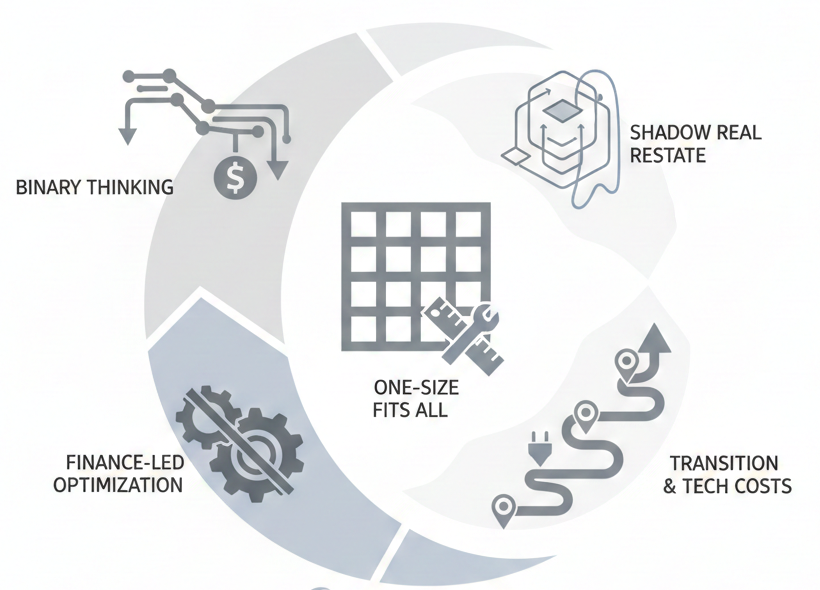
COMMON ENTERPRISE FAILURE PATTERNS
- Binary thinking: flex or traditional
- Finance-led optimization without operational nuance
- One-size-fits-all space standards
- Tactical flex procurement creating “shadow real estate”
- Ignoring transition, technology, and change adoption costs
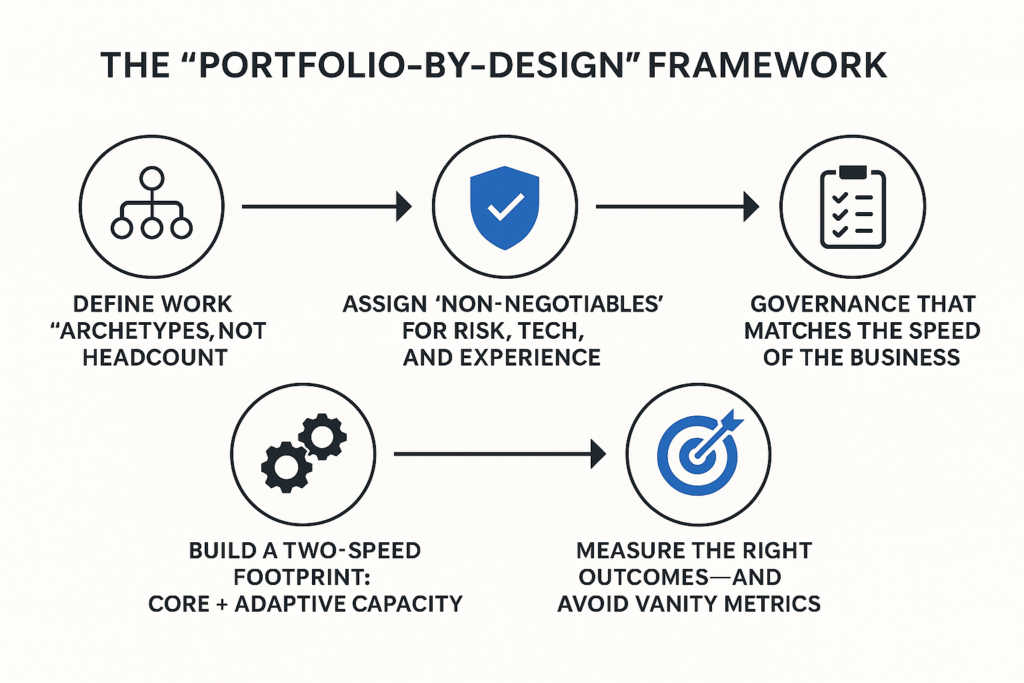
THE PORTFOLIO-BY-DESIGN FRAMEWORK
A rigorous approach replaces ideology with intent.
1) Define Work Archetypes (Not Headcount)
Plan from how work is performed, not org charts:
- Secure operations
- Collaboration-intensive product teams
- Specialist and infrastructure-heavy roles
- Client-facing teams
- Project and surge capacity
2) Establish non-negotiables
Minimum standards across all space:
- Security and access controls
- Network and endpoint baselines
- Facilities service levels
- Core employee experience expectations
Flex fails when it becomes an exception zone.
3) Design a Two-Speed Footprint
- Core footprint: stable, risk-sensitive, culture-critical work
- Adaptive capacity: growth, pilots, transformation waves
For finance, adaptive capacity is an option premium—budgeted, governed, and trigger-based.
4) Match Governance to Business Speed
Create a cross-functional footprint council covering:
- Finance
- Operations
- Technology and security
- HR
- Business leadership
Without this, flex spend becomes invisible—and permanent.
5) Measure Outcomes, Not Vanity Metrics
Go beyond utilization:
- Time-to-ramp
- Delivery stability
- Attrition hotspots
- Technology readiness compliance
- Total portfolio cost visibility
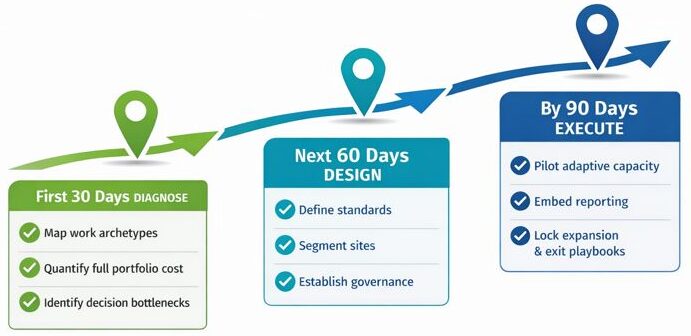
30–60–90 DAY ROADMAP
First 30 Days – Diagnose
- Map work archetypes
- Quantify full portfolio cost
- Identify decision bottlenecks
Next 60 Days – Design
- Define standards
- Segment sites
- Establish governance
By 90 Days – Execute
- Pilot adaptive capacity
- Embed reporting
- Lock expansion and exit playbooks
HOW CRESCO INTERNATIONAL ENABLES EXECUTION
Cresco bridges strategy and execution by aligning:
- Operating model design
- Portfolio and footprint strategy
- Governance and decision rights
- Vendor and service orchestration
- Change and adoption support
The focus is not theoretical optimization—but decisions that hold up under scrutiny and deliver in practice.
EXECUTIVE TAKEAWAYS
- Flex vs traditional is a portfolio risk decision, not a real estate debate
- The real cost includes transition, governance, and delivery friction
- Binary choices fail—core + adaptive portfolios scale
- Governance is the hidden value lever
- Measure outcomes tied to execution and talent, not occupancy alone
CONCLUSION: LEADERSHIP IS ABOUT CHOOSING WHICH RISKS YOU CARRY
Space decisions now sit at the center of execution.
Leaders who get this right:
- Plan from work archetypes
- Build stability with adaptability
- Govern space like any strategic asset
The payoff shows up in margins, resilience, talent, and scalable growth.
Get in Touch
If your organization is reassessing footprint commitments, GCC expansion, or flex versus long-term leasing strategy, Cresco International can help move the conversation from debate to decision—with a portfolio that is financially defensible and operationally executable.
A focused strategic discussion is often enough to surface hidden costs, clarify trade-offs, and define a practical 30-60-90-day path forward.