
The global race to adopt AI-driven decisioning, real-time analytics, and autonomous automation has crossed a critical threshold. In 2025, enterprise success is no longer constrained by data availability, cloud infrastructure, or algorithmic capability. The true limiting factor is governance.
More specifically, it is the failure to translate governance from static policy into executable architecture.
Organizations that continue to treat governance as documentation struggle to scale AI safely and profitably. In contrast, those that operationalize governance as a runtime capability consistently outperform peers in speed, compliance, and financial returns. Governance has quietly become the control plane of modern AI.
THE 2025 GOVERNANCE CRISIS: WHY TRADITIONAL MODELS FAIL AI AT SCALE
Traditional data governance frameworks were built for a fundamentally different era. They assumed centralized ownership, predictable schemas, periodic audits, and human-mediated controls. AI systems break all four assumptions simultaneously.
AI amplifies ambiguity. It consumes data from heterogeneous sources, adapts continuously, and makes probabilistic decisions at machine speed. Static governance models cannot keep pace.
What the Data Shows
Enterprise data from late 2025 exposes a widening execution gap:
- The Scaling Bottleneck
McKinsey reports that while 88 percent of enterprises now use AI in at least one function, only one-third have successfully scaled AI across business units. The primary inhibitor is not model performance but fragmented governance and inconsistent data controls. - The Boardroom Disconnect
Although 62 percent of boards regularly discuss AI strategy, only 27 percent have embedded AI governance into formal committee charters. This gap between strategic intent and operating infrastructure leaves organizations exposed to regulatory, reputational, and financial risk. - Regulatory Escalation
Under the EU AI Act, non-compliance penalties can reach 7 percent of global turnover. IBM’s 2025 breach analysis indicates that 97 percent of AI-related data incidents occurred in environments lacking execution-layer access controls. - The Velocity Divide
High-maturity organizations sustain AI initiatives for more than three years at twice the rate of low-maturity peers. Longevity correlates directly with automated governance, not experimentation budgets.
- The Scaling Bottleneck
The conclusion is unavoidable: governance failure is now the dominant reason AI initiatives stall after pilot phases
REFRAMING GOVERNANCE: FROM POLICY TO RUNTIME ARCHITECTURE
Modern governance is no longer a checkpoint or approval workflow. It is an always-on execution layer embedded directly into how data and models are accessed, combined, and consumed.
The shift is architectural, not procedural.
Governance as a Runtime Capability
In high-performing organizations, governance operates continuously across the AI lifecycle:
- Data ingestion and access
- Feature engineering and model training
- Model deployment and inference
- Monitoring, retraining, and retirement
Controls are enforced automatically at the moment of data request or model execution, not retroactively through audits. This is what enables both speed and trust.
Organizations looking to modernize this layer often start with an architecture-led governance assessment, not a policy rewrite. This is where execution-focused partners like Cresco International play a critical role.
Learn more about Cresco’s governance-first AI architecture approach: https://www.crescointl.com
THE LOGICAL DATA FABRIC: FOUNDATION OF EXECUTABLE GOVERNANCE
At the core of this shift is the Logical Data Fabric (LDF).
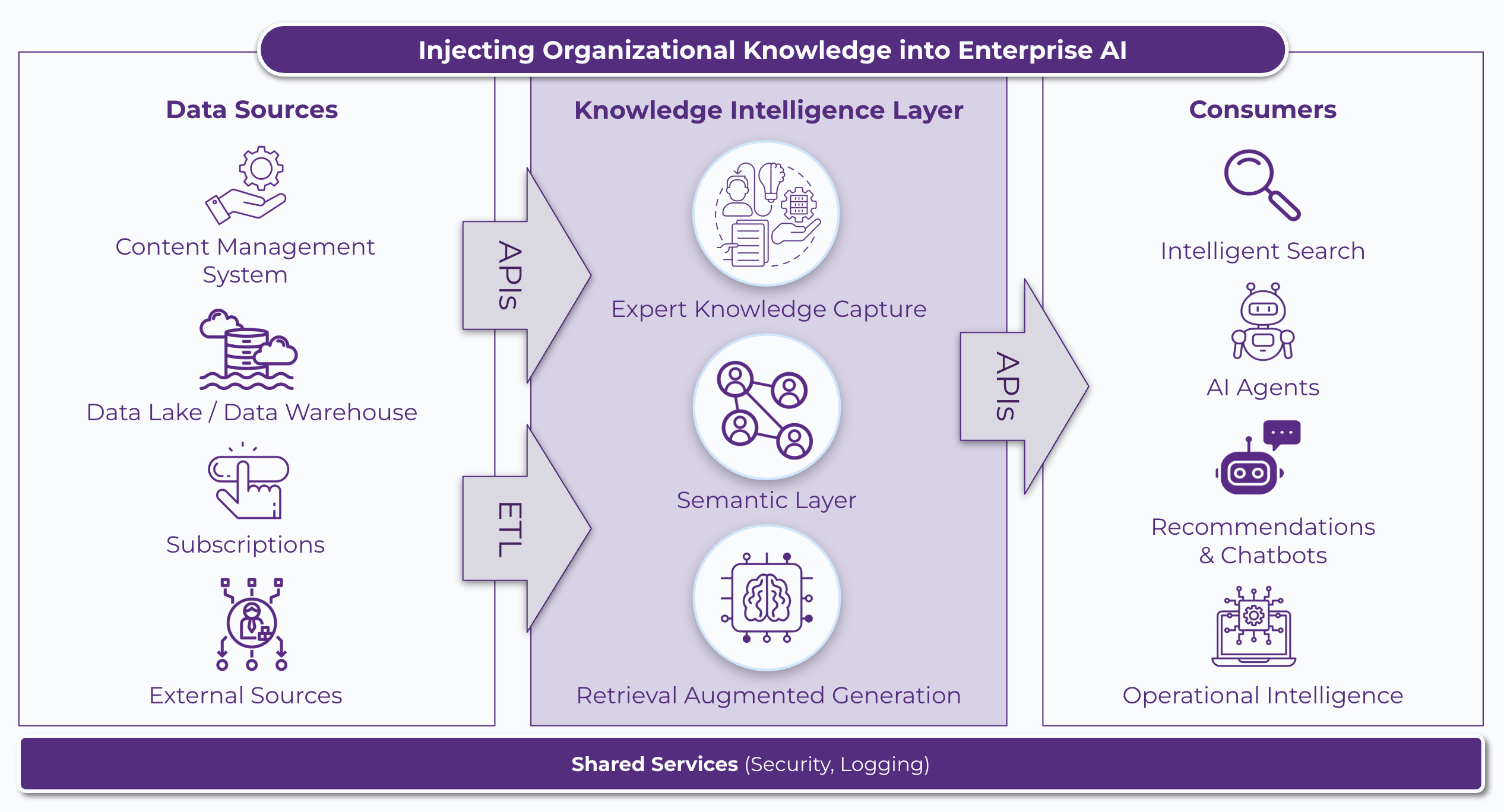
Rather than consolidating data into massive, brittle lakes, a Logical Data Fabric enables governed access to data where it already resides, across cloud, on-premise, and third-party systems.
Key Architectural Capabilities
- Unified Semantic Layer:
Business definitions, metrics, and relationships are standardized once and reused everywhere. AI models, dashboards, and applications all operate on the same semantic truth. - Active Metadata:
Metadata is not passive documentation. It actively drives access control, lineage tracking, data quality enforcement, and policy execution in real time. - Policy-as-Code:
Governance rules are translated into executable logic. Every query, API call, or model inference is evaluated dynamically against compliance, consent, and risk policies.
- Unified Semantic Layer:
This approach removes the historical lag between governance intent and operational enforcement, a gap that Cresco specifically designs architectures to eliminate.

INDUSTRY EXECUTION: GOVERNANCE WHERE IT ACTUALLY BREAKS
- Healthcare: Interoperable Trust at Machine Speed:
The AI healthcare market is approaching 613 billion dollars, driven by clinical decision support, predictive diagnostics, and agentic AI workflows. Yet trust remains fragile.
Eighty-three percent of patients express discomfort with AI-assisted diagnoses without strong oversight and data protection guarantees. - The Core Risk:
Healthcare data is both highly sensitive and highly fragmented. Traditional governance fails when AI models pull data from multiple clinical systems with inconsistent access rules. - Cresco’s Execution Model:
A zero-trust data posture is enforced at the logical access layer. Personally identifiable information is dynamically masked or tokenized before data reaches AI systems. Clinicians receive real-time insights, such as AI-flagged drug interactions, while sensitive identifiers never leave their secure sources.
This architecture allows healthcare organizations to scale AI responsibly without slowing clinical workflows.
FINANCIAL SERVICES: EXPLAINABILITY BY DESIGN
As global AI compliance spending accelerates toward one billion dollars annually, regulators now expect explain ability to be inherent, not optional.
Legal claims tied to opaque automated decisions are projected to double by 2029.
The Core Risk :
Most financial institutions can explain their policies but cannot reconstruct how a specific AI decision was made at a specific moment in time.
Cresco’s Execution Model:
End-to-end lineage is embedded directly into transaction flows. Each AI-driven decision is automatically tagged with source data, transformations, feature logic, and model versioning.
This enables continuous audit readiness and regulator confidence without manual reconstruction efforts.
RETAIL: CONSENT AT GLOBAL SCALE
Retail personalization now spans mobile apps, web platforms, physical stores, and IoT devices. Managing customer consent across millions of touchpoints is no longer feasible through manual systems.
The Core Risk
Consent fragmentation leads to accidental violations that trigger fines, brand damage, and customer churn.
Cresco’s Execution Model
Consent is governed through a unified semantic layer. When a customer revokes consent, their profile is instantly masked across all AI agents and marketing systems.
This prevents violations by architecture rather than relying on downstream enforcement.
EXTENDING GOVERNANCE ACROSS THE AI LIFECYCLE
One critical addition often overlooked is model governance.
Modern governance architectures must also address:
- Model risk classification
- Bias and fairness thresholds
- Drift detection and retraining triggers
- Version control and rollback
- Decommissioning of obsolete models
When governance stops at data access and ignores model behavior, risk simply shifts downstream. Cresco integrates data governance and model governance into a single execution fabric, ensuring accountability from raw data to AI-driven decision.
THE FINANCIAL CASE FOR EXECUTABLE GOVERNANCE
The impact of governance modernization is measurable and material.
Organizations operating under traditional governance models typically incur high audit and compliance costs due to manual, periodic controls and retrospective reporting. In contrast, enterprises that adopt a modern execution architecture reduce audit and compliance expenses by approximately 20 to 30 percent through automated, continuous enforcement embedded directly into data and AI workflows.
The ability to scale AI initiatives also diverges sharply between governance models. Under traditional governance, only about 20 percent of AI use cases successfully transition beyond pilot stages into enterprise-wide deployment. Modern execution architectures nearly double this outcome, enabling approximately 45 percent of AI initiatives to scale across business units with consistent governance and control.
Financial performance follows the same pattern. Companies constrained by static governance frameworks report returns on equity that average 3.8 percent below industry peers. Organizations that implement executable governance architectures, however, outperform peers by an average of 10.9 percent. This advantage is driven by faster time-to-value, reduced operational risk, and sustained AI adoption across the enterprise.
Risk exposure further underscores the difference. Traditional governance remains largely reactive, resulting in a higher likelihood of data breaches and regulatory violations. Automated governance enforcement at the execution layer significantly reduces breach and violation risk by applying access controls, lineage tracking, and compliance checks in real time.
Organizations that invest in governance execution consistently outperform those that invest only in experimentation
FINAL PERSPECTIVE: GOVERNANCE IS THE ENGINE OF AI, NOT THE BRAKE
In 2025, governance is no longer a supporting function or a compliance afterthought. It is a core runtime capability of the enterprise data and AI platform.
Organizations that embed governance directly into architecture move faster precisely because they control risk continuously. Those that rely on static policies trade speed for a false sense of security until regulators, customers, or markets force a correction.
At Cresco International, governance is not something we document. It is something we engineer, deploy, and operate.
MOVING FORWARD: FROM POLICY TO PERFORMANCE
The critical question for leadership teams is no longer whether governance policies exist. It is whether those policies execute automatically, scale across AI workloads, and hold up under regulatory scrutiny.
Cresco offers a Governance-to-Execution Maturity Assessment designed to:
- Map regulatory obligations to architectural controls
- Identify governance bottlenecks slowing AI scale
- Design a logical, execution-ready data and AI platform
If governance is limiting your AI velocity, the architecture—not the policy—is the place to start.
Explore how Cresco helps enterprises operationalize governance at scale: https://www.crescointl.com
Contact Cresco directly to begin your assessment: https://www.crescointl.com/contact-us
Governance can either be your bottleneck or your competitive advantage. The difference is execution.