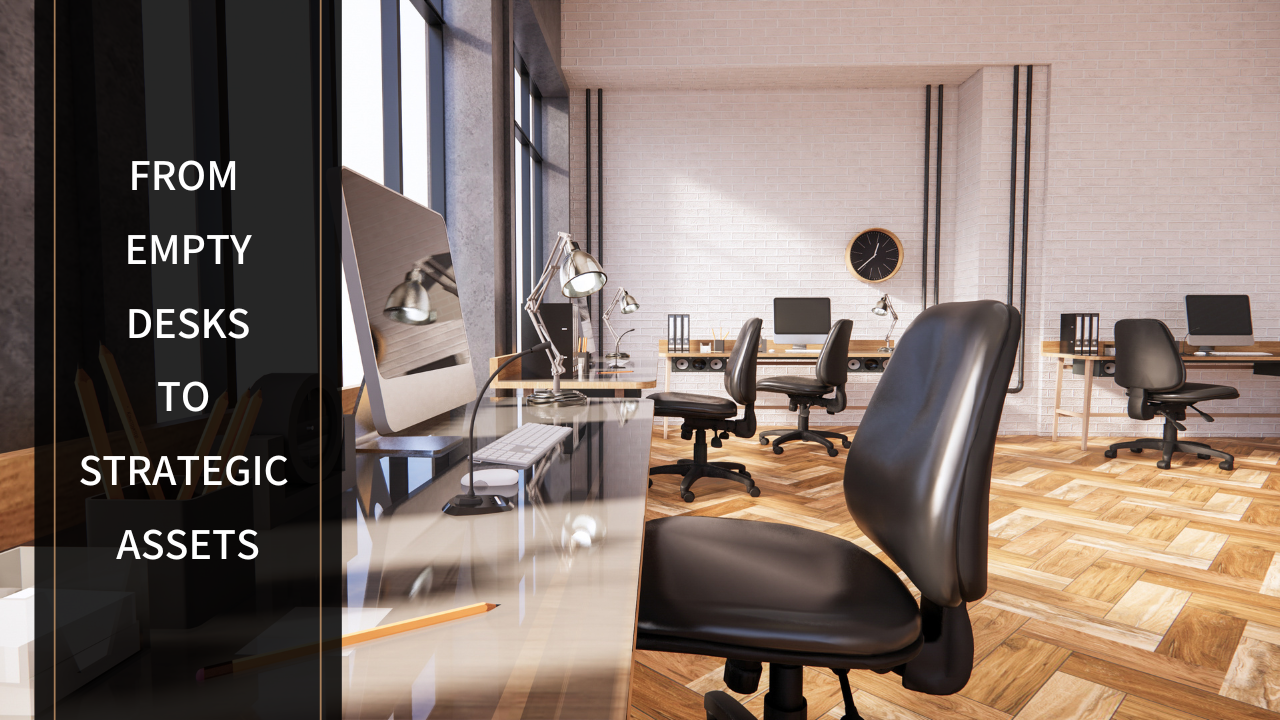

Leaders are no longer debating whether offices matter.
The real question is sharper—and far more expensive:
What is the office actually for—and is the way teams are using it improving execution or quietly eroding margins?
Across global enterprises—especially IT Services, BFSI, and complex delivery organizations—the office has drifted into a default container for work rather than a designed system for outcomes.
Attendance policies, hybrid norms, and space utilization are still discussed as “culture topics.”
But their consequences show up where boards pay attention:
delivery reliability · cost-to-serve · risk exposure · talent retention · margins
THE LEADERSHIP TENSION NO ONE STATES CLEARLY
Most leadership teams sense the problem before they can name it:
- People are back—but collaboration quality isn’t predictably better
- Real estate costs remain material—but utilization is uneven and hard to justify
- Managers see presence—but not necessarily productivity or accountability
- Teams meet more—yet decisions don’t move faster.
This isn’t a facilities issue. It’s not a remote-versus-office debate.
It’s an operating model failure—and it compounds over time.
Organizations that frame office usage as a binary choice miss the real dynamic:
Teams use offices the way work is governed, decisions are made, data flows, and accountability is enforced.
The leaders who get this right aren’t optimizing desks.
They are designing an execution system—physical and digital—where doing the right work is easier than doing the wrong work.
THE CORE PROBLEM: OFFICE USAGE HAS DRIFTED AWAY FROM WORK DESIGN
In most enterprises today, offices are being used for three inconsistent purposes:
- A symbol — visibility, culture, control
- A convenience — meetings, infrastructure, routine tasks
- A fallback — when remote execution breaks down
None of these are wrong on their own.
The failure is that they are unintentional, unmanaged, and disconnected from how work should flow.
The result is what leaders experience as “hybrid isn’t working.”

WHY THIS PROBLEM EXISTS (ROOT CAUSES, NOT SYMPTOMS)
- Work Was Relocated—Not Re-engineered
Processes designed for co-location were simply moved online.
When informal clarifications and rapid escalation disappeared, organizations responded by adding meetings, approvals, and check-ins—instead of redesigning the work.
- Decision Rights Became Visible—and Ambiguous
Hybrid environments expose what offices used to hide:
- unclear ownership
- undocumented decisions
- confusion over “who decides”
Offices then become decision theatres—decisions happen because people are present, not because the system works.
- Collaboration Is Confused with Coordination
Calendars fill up, but coordination quality stays low:
- messy handoffs
- unmanaged dependencies
- opaque work queues
The office becomes a place to talk about work, not move it forward.
- Space Strategy Is Detached from Value Creation
Facilities optimize cost-per-seat.
Business leaders care about throughput, quality, and time-to-decision.
Without a shared value model, office usage becomes a political negotiation—not a performance design choice.
- Measurement Rewards Presence, Not Outcomes
Badge swipes, occupancy rates, and attendance percentages are easy to track.
They correlate weakly—often negatively—with execution quality.
When leaders rely on them, they optimize visibility instead of value.
THE BUSINESS IMPACT: LARGER THAN IT APPEARS ON PAPER
Financial Impact
The visible costs are real estate and support services.
The hidden costs are far larger:
- rework and delays
- duplicated effort
- slower onboarding
- rising management overhead
These surface as margin compression, not line-item expenses.
Operational Impact
- Decision latency increases
- Cross-functional execution slows
- Issues escalate later and cost more
- Meetings multiply, outcomes don’t
Talent Impact
- High performers disengage or leave
- Managers burn out coordinating through noise
- “Hybrid” becomes an inconsistent experience across teams
Competitive Impact
- Customers experience variability.
- Response times slip.
- Innovation cycles lengthen.
Competitors with tighter operating discipline win—even with similar talent and technology.

THE COST OF INACTION: DYSFUNCTION COMPOUNDS
Doing nothing does not preserve the status quo—it hardens failure modes:
- Meetings become the default coordination mechanism
- Decisions happen “in the room,” not in the system
- New hires take longer to become effective
- Performance management becomes subjective
- Real estate turns into a fixed cost with declining strategic return
The real risk isn’t hybrid itself.
It’s the slow erosion of execution capacity.
WHAT HAS FUNDAMENTALLY CHANGED (AND WHY OLD FIXES FAIL)
1. Work Is Now Dependency-Heavy and Cross-Border
- Shared services, GCCs, platforms, partners, and multi-region teams increase coordination complexity.
- The office can’t just be a place—it must be a friction-reduction mechanism.
2. Talent Expectations Have Shifted
- Flexibility is expected. But flexibility without work design creates chaos.
- Winning organizations offer autonomy with clarity: clear outcomes, clean handoffs, disciplined decision rights.
3. Traditional Responses No Longer Work
- Mandates increase resentment without improving throughput
- Perks-based redesigns improve experience, not execution
- Manager-by-manager discretion creates inequity and inconsistency
4. Emerging Reality Leaders Must Accept
- Work is increasingly invisible
- Asynchronous execution is unavoidable
- Risk and compliance scrutiny is rising (especially in BFSI)
- AI and automation amplify poor processes—you can’t automate ambiguity
THE WORKPLACE EXECUTION FRAMEWORK
A practical model for aligning office usage with execution outcomes
W — Work Segmentation
Define which work truly benefits from co-presence—and why.
Segment work into:
- Deep individual work
- High-stakes collaboration
- Transactional coordination
- Sensitive / risk-critical work
Identify “moments that matter” where co-location measurably improves outcomes.
O — Operating Cadence
Replace meeting sprawl with a disciplined rhythm of execution.
- Decision-focused forums with logs
- Cross-functional dependency reviews
- Performance reviews tied to customer outcomes
If a meeting doesn’t end in a decision, commitment, or risk resolution—redesign it.
R — Roles, Decision Rights, Accountability
Remove ambiguity that forces people to “come in to get things done.”
- Clear ownership for recurring decisions
- Decision records with rationale and impact
- Outcome-based management—not visibility-based control
K — Knowledge Flow & Tool Discipline
Make work legible, transferable, and auditable.
- One source of truth for work and decisions
- Reduced tool sprawl
- Lightweight standards: decision logs, playbooks, templates
If it isn’t captured, it didn’t happen.
P — Place Design
Design space around work—not tradition.
- Project rooms
- Team collaboration zones
- Quiet focus areas
- Hybrid-equitable meeting rooms
Treat the office as a portfolio of environments, not a single layout.
L — Leadership Signals
Hybrid fails when trust erodes.
- Model purposeful presence
- Set clear non-negotiables
- Build manager capability for outcome-based leadership
Culture is shaped by what leaders tolerate.
A — Analytics That Matter
Link office usage to outcomes—not optics.
Track:
- Decision lead time
- Cycle time and throughput
- Rework rates
- Customer response times
- Onboarding time-to-productivity
Occupancy is secondary—never the headline metric.
C — Cost & Commercial Guardrails
Anchor office strategy in value logic.
- Where does co-presence improve outcomes?
- What costs are fixed vs variable?
- What can be proven in 90 days?
The answer to CFO scepticism is evidence—not opinion.

A PRACTICAL 30–60–90 DAY PATH
Days 1–30: Diagnose
- Map critical workflows and friction points
- Identify moments that matter
- Baseline decision speed, meeting load, cycle time
Days 31–60: Redesign & Pilot
- Redesign cadence and decision rights
- Set collaboration principles
- Pilot in 1–2 business lines
Days 61–90: Scale
- Expand what works
- Standardize tool discipline
- Lock governance to operational metrics
HOW CRESCO INTERNATIONAL HELPS
Organizations don’t fail due to lack of intent.
They fail because this problem sits across operating model, process, technology, and talent—with no single owner.
Cresco International brings an execution-first approach:
- Operating model alignment
- Workflow and process redesign
- Tool and knowledge discipline
- Flexible talent and managed services
- Rapid pilots with measurable outcomes
The goal isn’t more office days. It’s better execution.
EXECUTIVE TAKEAWAYS
- Office usage is an operating model decision—not a facilities debate
- Presence is a weak proxy for performance
- Hybrid fails when decision rights are unclear
- Design moments that matter—make everything else reliably async
- Prove value in 90 days, not policy decks
FINAL THOUGHT: TREAT THE OFFICE AS A PERFORMANCE SYSTEM
The strongest leaders have moved beyond remote vs. in-office.
They understand the office is now one component of a broader execution system.
If teams use offices to compensate for broken coordination, unclear ownership, or weak documentation—you pay twice.
But when office usage is designed around work that truly benefits from co-presence—and everything else is engineered for clarity and speed—hybrid becomes a measurable advantage.
This is leadership work. And it’s no longer optional.