Across global enterprises today, leaders are being squeezed from both ends.
Customers expect faster, more consistent, and more personalized experiences, while boards demand margin discipline, predictable execution, and tighter risk control. In response, organizations launch transformation programs, expand shared services, invest heavily in digital platforms, and announce operating model shifts.
Yet despite the ambition and spend, outcomes often stall.
The pattern is familiar:
- Standardization initiatives trigger local resistance
- Centralization creates bottlenecks and slows decision-making
- Decentralization increases cost, control risk, and fragmentation
- Technology modernization exposes deep process debt and unclear ownership
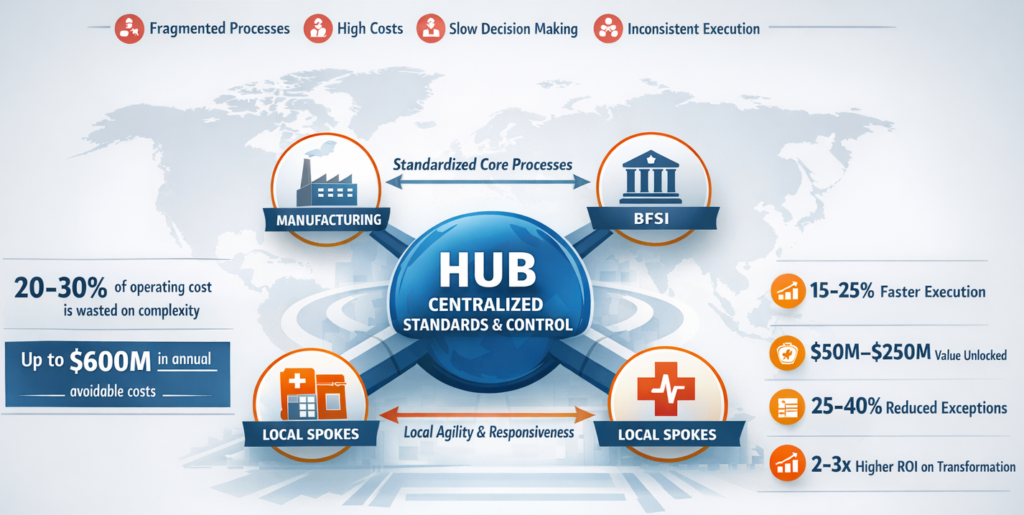
This tension is why the hub-and-spoke model has returned to boardroom conversations across manufacturing, BFSI, retail, IT services, logistics, healthcare, and pharma—particularly for global enterprises and multinational GCC networks trying to scale delivery without sacrificing agility, accountability, or control.
The opportunity is real. So are the risks.
A hub-and-spoke model can become a scalable execution backbone—or just another layer of organizational complexity if designed without discipline.
THE REAL TENSION LEADERS FACE
The core challenge is not choosing between centralization or decentralization.
It is learning how to scale efficiency and control without destroying speed, ownership, and customer responsiveness.
Enterprise complexity has quietly outpaced operating models:
- Multiple geographies, business units, and regulatory regimes
- Structural talent shortages in digital, analytics, cybersecurity, and niche domain skills
- Rising expectations for real-time reporting, auditability, and compliance
- Technology landscapes built over years of local workarounds and exceptions..
According to McKinsey Global Institute, 20–30% of enterprise operating cost is tied to non–value-adding complexity.
For a $5B global enterprise, this often translates to $300M–$600M in avoidable annual cost.
Most transformations fail not because strategy is wrong—but because the operating model is never fundamentally redesigned. Teams are moved into “centers,” work is re-labelled, but decision rights, accountability, and ownership remain fragmented.
A well-designed hub-and-spoke model is not a re-org.
It is an execution architecture that deliberately separates:
- What must be globally consistent
- From what must remain close to customers, markets, and regulators

THE CORE PROBLEM—AND WHY IT HURTS THE BUSINESS
Why this problem exists (root causes) ?
Most enterprises did not design their operating models. They accumulated them over time.
Three forces collide.
- Local optimization becomes enterprise drag
Business units naturally build processes optimized for local speed and constraints. Individually, these decisions make sense. At scale, they create:
- Process proliferation
- Inconsistent controls
- Higher technology and integration costs
Global organizations typically maintain 5–10 variants of the same core process (e.g., Order-to-Cash or Procure-to-Pay).
Each additional variant increases rework by 8–12% and control exceptions by 15–20%.
For a global Order-to-Cash process handling $10B+ in annual revenue, unmanaged variation can lock up $150M–$300M in working capital and delay cash realization.
- Central functions grow—but without outcome ownership
Shared services and centralized teams often inherit tasks, not accountability.
They process transactions but lack authority to fix upstream issues such as:
- Poor master data quality
- Ambiguous policies
- Broken handoffs
- Weak controls
Deloitte’s Global Shared Services research shows that over 65% of shared services organizations fail to achieve expected ROI within 24 months, largely due to unclear scope and weak decision rights.
Organizations targeting $40M–$120M in annual run-rate savings frequently see 30–40% of that value erode within three years when ownership and governance are not redesigned.
- Digital investments amplify weak design
Automation, analytics, and AI do not fix broken operating models.
They scale whatever already exists.
Global studies by McKinsey and Bain indicate that 30–50% of automation and AI programs fail to scale beyond pilots. The average large enterprise spends $20M–$50M annually on digital platforms, yet captures less than 40% of potential value when processes lack stability and ownership.
Organizations that redesign operating models before automating achieve 2–3x higher ROI and 12–18 months faster payback.
Business Impact Across the Enterprise
When the operating model is misaligned, the impact is systemic.
Financial
- Rising run-rate costs and duplicated roles
- Inconsistent working capital performance
- Uncontrolled exceptions and value leakage
Enterprises without standardized execution models often carry 10–18% higher SG&A as a percentage of revenue than peers.
Operational
- Wide cycle-time variability across regions
- SLA misses and quality escapes
- Constant escalation-driven firefighting
People
- Role ambiguity and burnout
- Shadow teams created to “get work done”
- Limited internal mobility and unclear career paths
Gartner estimates role ambiguity alone can reduce enterprise productivity by up to 20%, equating to $80M–$150M in lost productivity annually for a 20,000-employee organization.
Risk & Compliance
- Fragmented controls
- Higher audit remediation costs
- Slower regulatory response
According to PwC, fragmented operating models lead to 2–3x higher audit remediation costs and 25–40% more control exceptions per audit cycle. Regulatory failures can cost $5M–$50M per incident, excluding reputational damage.
If leaders do nothing!!!
- Cost rises faster than revenue.
- Risk exposure increases.
- Leadership responds with more controls, more reporting, more approvals—slowing execution further.
This is how complexity becomes a strategy tax.
WHAT HAS CHANGED—AND WHY OLD MODELS FAIL
The environment is fundamentally different
- Scale is multi-dimensional: volume, product complexity, channels, data intensity, and regulation
- Talent scarcity is structural, not cyclical
- Risk is real-time, not retrospective
- Customers benchmark experiences across industries, not peers
A bank is judged against e-commerce speed.
A healthcare provider is compared to consumer-grade digital platforms.
Why traditional approaches no longer work
- “Centralize everything” creates bottlenecks and exception overload
- “Let every unit decide” destroys enterprise visibility and cost discipline
- “Just automate it” scales inconsistency
What’s needed is a model that standardizes the core while preserving local context and responsiveness.
Common failure patterns in hub-and-spoke adoption
- The hub becomes a super back office with approvals but no authority
- Spokes are treated as exceptions, not strategic capabilities
- Decision rights are unclear—work moves, accountability doesn’t
- Metrics reward activity, not outcomes
- Technology becomes the model instead of enabling it
THE 5-D HUB-AND-SPOKE EXECUTION MODEL
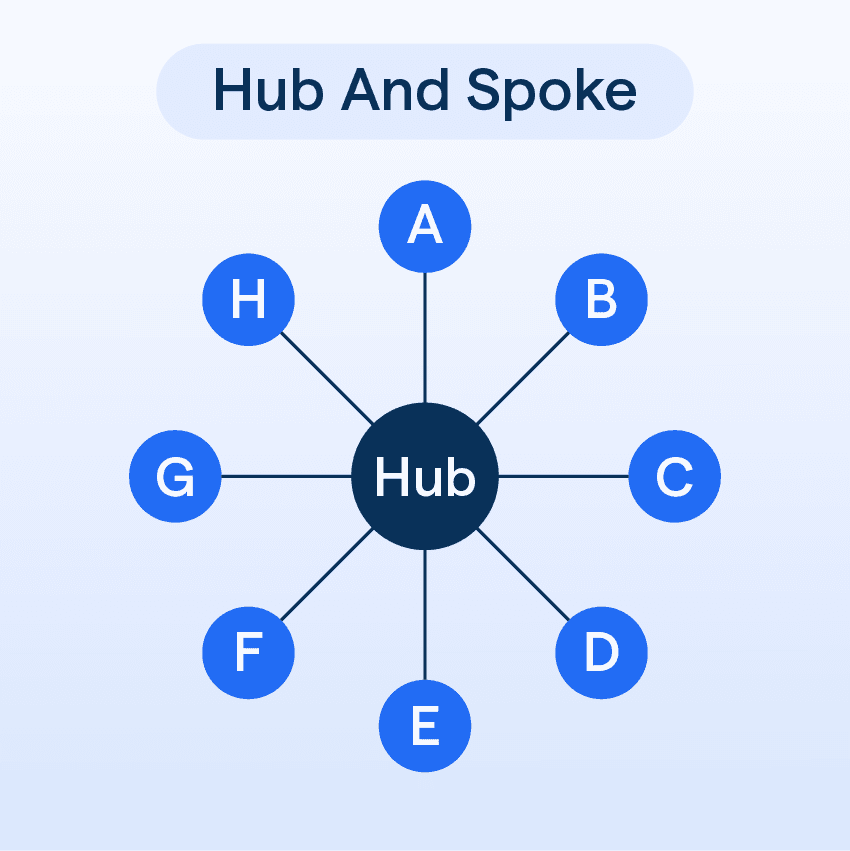
Hub-and-spoke works only when engineered as an execution system, not an org chart.
1) Decide the non-negotiables
Define what must be globally consistent:
- Policies and control standards
- Master data definitions and ownership
- Core process design (the “80% standard”)
- Minimum technology, security, and compliance standards
The objective is disciplined consistency—not uniformity.
2) Design the Work: Core vs. Context
Separate work by value contribution:
- Core (Hub): repeatable, scalable, control-intensive
- Context (Spoke): market-facing, regulation-specific, customer-sensitive
End-to-end value stream mapping is essential to distinguish value-adding variation from accidental variation.
3) Define Decision Rights and Escalation Paths
Every process must have:
- A single end-to-end owner
- Clear RACI across hub, spoke, and business units
- Time-bound escalation paths
Outcome ownership—not just cost—must be explicit.
4) Deploy Governance That Enables
Effective governance is decision-oriented:
- Weekly: operational exceptions and bottlenecks
- Monthly: outcomes, risks, capacity, improvement
- Quarterly: scope changes, regulatory shifts, technology alignment
Well-designed hub-and-spoke governance reduces compliance cost by 15–25% while improving audit traceability.
5) Drive Adoption Through Capability and Change
Hub-and-spoke succeeds when people understand:
- What changed
- Why it changed
- How they succeed in the new model
This includes:
- Role-based enablement
- Outcome-aligned KPIs
- Clear talent pathways between hub and spoke
- Phased transitions—not big-bang moves
Organizations with defined hub–spoke career pathways see 15–25% lower attrition in critical roles and 20–30% higher internal mobility.
A PRAGMATIC 30–60–90-DAY ROADMAP
Days 0–30: Diagnose & Align
- Map 3–5 critical value streams
- Identify value-adding vs accidental variation
- Define decision-right principles and non-negotiables
Days 31–60: Design & Prove
- Design hub–spoke split for one value stream
- Define outcome-based KPIs and governance
- Pilot in one region or business unit
Days 61–90: Scale with Control
- Extend to adjacent processes and regions
- Stand up ownership and escalation mechanisms
- Align technology and data governance
Sequence matters: operating clarity first, technology second.
HOW CRESCO INTERNATIONAL ENABLES THIS JOURNEY
Organizations don’t struggle with the concept of hub-and-spoke.
They struggle with execution across functions, geographies, and legacy constraints.
Cresco International supports enterprises across:
- Operating model and transformation design
- GCC setup, scale, and governance
- Finance & accounting process optimization
- Talent solutions and managed services
- Digital and operating model alignment
More than 70% of Fortune 500 companies operate multi-location GCCs, yet only one-third successfully scale beyond cost efficiency into capability-led value creation. Cresco focuses on bridging that execution gap—turning intent into measurable outcomes.
EXECUTIVE TAKEAWAYS
- Hub-and-spoke is an execution architecture, not a re-org
- Most failures stem from unclear decision rights, not the model
- Design the operating model before automating it
- Governance must enable speed—not slow it
- Start with one value stream, prove outcomes, then scale
Enterprises that get this right typically achieve:
- 10–20% reduction in run-rate operating cost
- 20–30% cycle-time improvement
- 25–40% reduction in exception handling
- $50M–$250M in value unlocked over 3–5 years
CONCLUSION
The renewed relevance of the hub-and-spoke model reflects a deeper enterprise reality: organizations must grow, digitize, and globalize without losing execution discipline.
The real work is not choosing hub versus spoke—it is deciding what belongs where, clarifying ownership, and building governance that enables faster, cleaner execution with fewer surprises.
Done right, hub-and-spoke becomes a strategic advantage—strengthening margins, reducing risk, improving customer experience, and creating a scalable foundation for digital acceleration.
CALL TO ACTION
If you are evaluating a hub-and-spoke model—for a GCC strategy, shared services redesign, or enterprise operating shift—Cresco International can help you pressure-test the design, clarify trade-offs, and build an execution roadmap grounded in operational reality.
Start a conversation with Cresco International to explore what a pragmatic, outcome-driven hub-and-spoke model could look like for your organization—across functions, geographies, and growth ambitions.