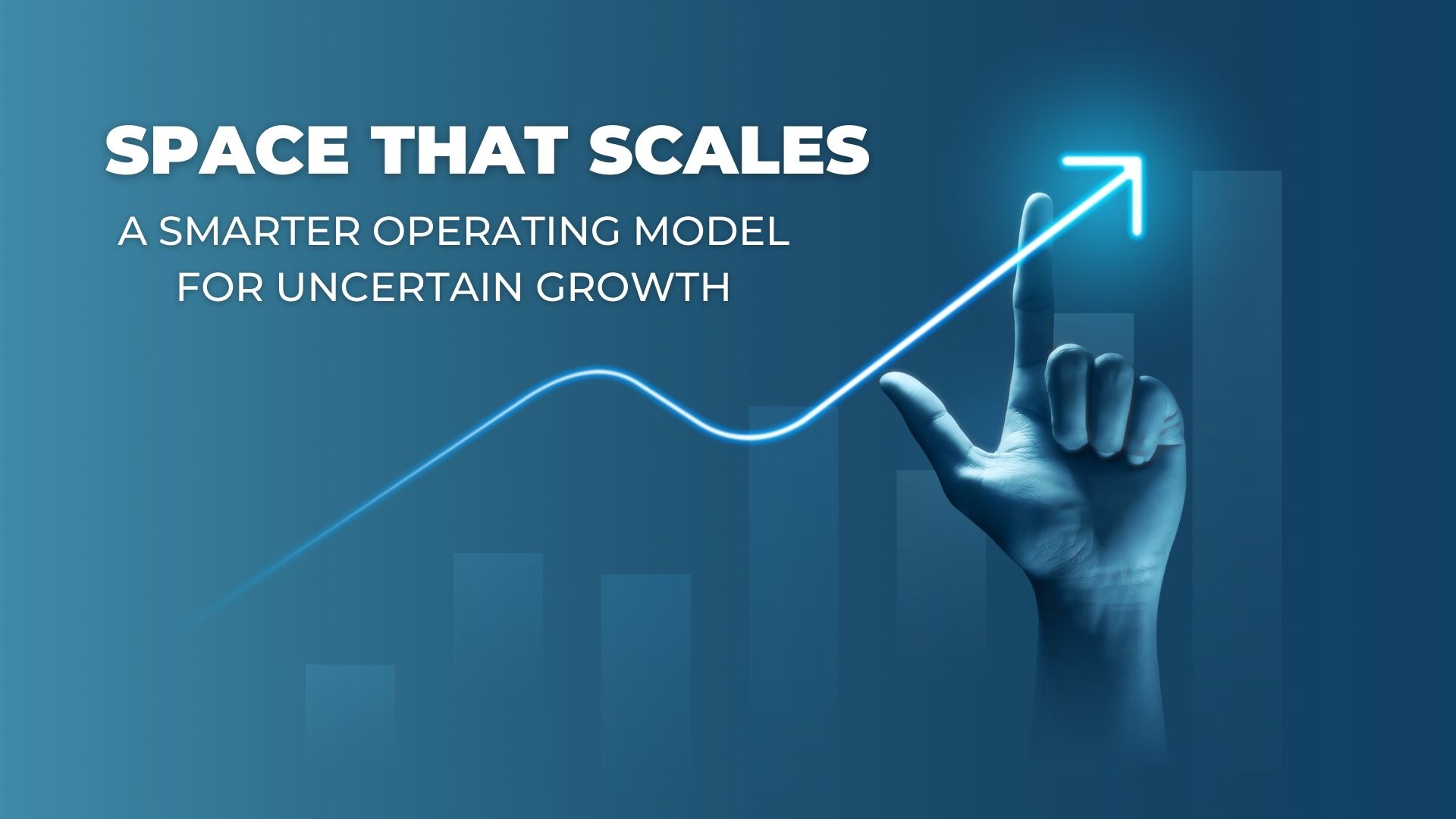

In today’s operating environment, CEOs, CFOs, COOs, and GCC leaders face a contradiction that did not exist a decade ago: they are expected to scale growth, protect margins, and maintain governance rigor—even as demand signals grow noisier, talent markets tighten, and regulatory expectations intensify.
One quarter call for aggressive expansion. The next demands cost rationalization, hiring pauses, or post-acquisition integration. Customers expect faster delivery cycles. Regulators expect stronger controls. Talent expects flexibility.
This is why scaling space up/down has shifted from a facilities discussion to a board-level operating model decision.
“Space” is no longer about square footage. It is a proxy for capacity—and capacity determines whether an enterprise can absorb volatility, meet revenue commitments, and preserve unit economics across multi-region and globally distributed operations.
Organizations that treat scaling as a real-estate problem often experience a predictable arc: rapid tactical expansion, followed by operational complexity, then a gradual erosion of productivity and control.
The leaders that outperform are those that design elastic capacity by intent—where space, talent, process, technology, and governance scale together.
Secondary keywords: flexible workspace strategy, workforce capacity planning, Global Capability Center (GCC) expansion, operating model agility, managed services model, business process optimization
THE EXECUTIVE REALITY: WHY SCALING HAS BECOME HARDER
Most leadership teams are not debating whether to scale. They are debating how to scale without locking in structural risk.
The tension shows up daily:
- Business leaders push for speed: “We need 300 seats in 60 days.”
- Finance leaders demand discipline: “We can’t carry fixed costs into uncertainty.”
- Risk, IT, and Security insist on control: “Expansion cannot outpace compliance readiness.”
- HR leaders focus on sustainability: “Headcount growth without leadership bandwidth destroys engagement.”
This is the true challenge of scaling space up/down. It sits at the intersection of growth, economics, resilience, and governance. The question is not how many desks you have—but whether your enterprise can expand and contract capacity with predictable outcomes.
In volatile markets, the cost of getting this wrong is material. Enterprises that scale intelligently capture growth windows and defend margins. Those that scale reactively accumulate inefficiency, tech debt, and risk exposure that can take years to unwind.
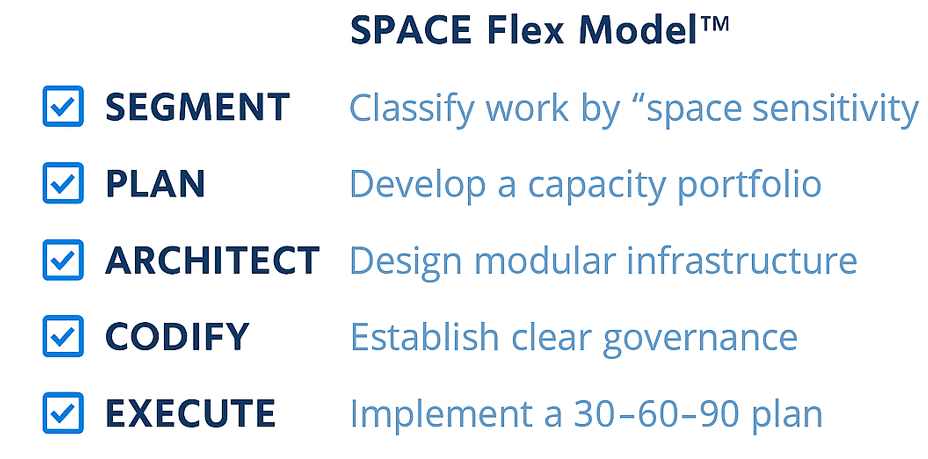
THE CORE PROBLEM AND ITS BUSINESS IMPACT
Why scaling breaks down? (systemic root causes)
Across BFSI, IT services, healthcare, pharma, manufacturing, retail, and logistics, five structural issues repeatedly surface.
- Demand volatility is now structural
Forecast accuracy has declined as customer behavior, supply chains, pricing, and competitive dynamics shift faster. Capacity models built around a single “most likely” scenario routinely fail—creating either revenue leakage or idle cost. - Space is planned separately from the operating model
Footprint, hiring, process readiness, and technology enablement are often planned in parallel—not as one integrated system. Facilities may be ready while onboarding, access controls, or workflows lag behind. - Hybrid work has fragmented capacity needs
Not all work requires the same environment. Yet many organizations still allocate space by hierarchy rather than work criticality—creating either unnecessary cost or unacceptable risk. - Process immaturity multiplies complexity
When workflows are not standardized, every additional seat increases variation—more supervision, more rework, more exceptions. Capacity grows, but productivity does not. - Governance is slow or unclear
Scaling decisions span Finance, HR, Operations, IT, Facilities, and Risk. Without clear decision rights, organizations scale in pockets—duplicating capabilities and weakening controls.
- Demand volatility is now structural
THE HIDDEN COST—EVEN WHEN SCALING “WORKS”
From a CFO lens
- Long-term leases and fit-outs reduce financial optionality
- Underutilized space becomes persistent margin leakage
- Urgent expansions carry a “rush premium” across vendors and tooling
- Cost-to-serve rises when productivity fails to scale with headcount
From a COO lens
- Quality and predictability decline during rapid expansion
- Coordination overhead increases across locations
- Transition risk peaks when people, systems, and processes change simultaneously
- Resilience gaps emerge when footprint expands faster than continuity planning
From a CHRO lens
- Hiring surges overwhelm onboarding and managers
- Culture dilution increases attrition risk
- Inconsistent ways of working erode engagement and internal mobility
From a CIO/CISO lens
- Security and identity controls lag growth
- Non-standard endpoints and networks increase audit exposure
- “Temporary” tools create long-term tech debt
- Compliance retrofits disrupt steady-state operations
If leaders do nothing, they drift into one of two traps: over-commitment (fixed cost drag) or chronic firefighting (governance erosion).
WHAT HAS FUNDAMENTALLY CHANGED
- Capacity is no longer linear
More people and more space no longer guarantee more output. Throughput is constrained by process maturity, systems, leadership bandwidth, and governance. - Speed expectations have compressed
Traditional lease-and-build timelines cannot keep pace with modern business cycles, regulatory change, or market entry requirements. - Control expectations have increased
Hybrid and distributed delivery have not reduced scrutiny. Enterprises must now deliver flexibility and control simultaneously. - Talent markets amplify risk
GCC ecosystems, emerging delivery hubs, and high-cost markets penalize mis-scaling faster—through cost, attrition, and reputational impact.
- Capacity is no longer linear
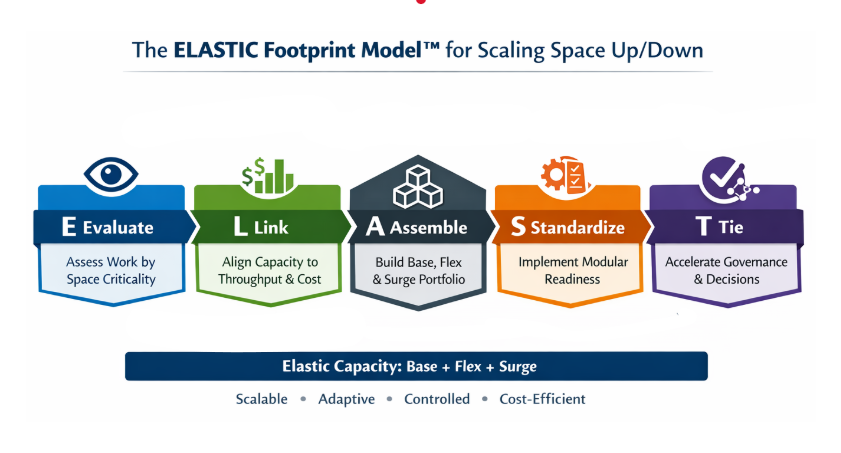
THE ELASTIC FOOTPRINT MODEL™
A repeatable executive framework for scaling space up/down
E — Evaluate work by space criticality
Segment work into:
-
-
-
- Control-critical (regulated, sensitive data)
- Collaboration-critical (product, transformation, leadership-heavy)
- Execution-critical (standardized operations)
- Flex-critical (seasonal, project-based demand)
-
-
Outcome: Right-sized environments without overbuilding.
L — Link capacity to throughput and unit economics
Shift the question from “How many seats?” to:
“How much output, at what quality and cost?”
Anchor decisions in:
- Throughput baselines
- Cost-to-serve visibility
- Constraint mapping (systems, approvals, rework)
A — Assemble a capacity portfolio
-
-
-
- Base capacity: steady-state demand
- Flex capacity: modular space, flexible staffing, managed services
- Surge capacity: short-term expansion with predefined controls
-
-
Critically, define exit and repurpose triggers, not just expansion triggers.
S — Standardize modular readiness
Speed comes from repeatability:
- Fit-out and secure zone templates
- Pre-approved IT and access blueprints
- Role-based onboarding waves
- SOPs that travel across locations
T — Tie governance to decision velocity
Effective governance accelerates scale:
- Clear approval thresholds
- Monthly capacity reviews tied to demand signals
- Named owners across readiness dimensions
- A single dashboard: throughput, quality, attrition, utilization, cost
30–60–90 DAY EXECUTIVE ROADMAP
-
-
-
- 0–30 days: Diagnose and de-risk
- 31–60 days: Build the portfolio and playbook
- 61–90 days: Pilot, measure, institutionalize
-
-
This cadence turns scaling into a managed capability, not an episodic scramble.
HOW CRESCO INTERNATIONAL SUPPORTS LEADERS
Cresco International helps enterprises make scaling space up/down a repeatable operating capability, not a one-time expansion project.
We typically support leaders across:
- Capacity and operating model strategy
- GCC setup and scalable delivery design
- Finance, accounting, and control-ready operations
- Business process optimization to reduce structural capacity needs
- Managed services and elastic talent models
- Digital, security, and governance alignment
The objective is simple: predictable scale with controlled economics.
EXECUTIVE TAKEAWAYS
- Scaling space up/down is an operating model decision, not a facility one.
- Optimize throughput and cost-to-serve, not seat utilization.
- Build a base–flex–surge capacity portfolio with exit triggers.
- Standardization is the fastest path to both speed and control.
- Governance should increase decision velocity, not slow it down.
CLOSING PERSPECTIVE
In volatile markets, scaling space up/down is no longer tactical. It is a strategic differentiator that determines whether enterprises can grow, protect margins, and sustain compliance across global operations.
The winners will not be those with the largest footprint—but those with the most elastic one.
That is the leadership opportunity: to turn scaling from recurring disruption into a durable competitive advantage.