
Executive Summary: The Enterprise Data Paradox of 2025
In 2025, enterprises are not suffering from a lack of data.
They are suffering from a lack of usable, trusted, and timely data.
Despite massive investments in cloud platforms, lakehouses, and AI pilots, most GenAI initiatives stall at the same uncomfortable realization:
The AI doesn’t know which data to trust, where it lives, or whether it is even allowed to see it.
This is the last-mile problem of GenAI — and it has nothing to do with model quality.
A Logical Data Fabric (LDF) solves this problem by acting as the intelligent connective tissue between enterprise data, AI systems, and business users. Instead of endlessly copying data into centralized platforms, LDF enables real-time, governed access to data where it already lives, enriched with business meaning through a unified semantic layer.
At Cresco International, we believe the future of enterprise data is not about building larger data lakes.
It is about building smarter access paths.
Don’t build bigger haystacks. Build magnets.
WHY THIS MATTERS NOW: THE 2025 DATA BREAKING POINT
For over a decade, the modern data strategy followed a simple belief:
If we move all our data into one place, insight will naturally follow.
This approach powered the rise of data warehouses, data lakes, and lakehouses. But in the era of GenAI, that assumption is collapsing under its own weight.
- The Velocity Gap
Business data today moves faster than any batch pipeline can keep up with.
- Inventory changes hourly.
- Supply chains react in real time.
- Customer behavior shifts instantly.
By the time data is extracted, transformed, and loaded into a central platform, it is already outdated. GenAI agents trained on stale data inevitably produce stale decisions.
- The Context Gap
Large Language Models do not inherently understand business meaning.
They don’t know:
- What “revenue” means across finance, sales, and operations
- Which KPIs are approved versus experimental
- Which joins and calculations are valid
Without a semantic layer, GenAI systems may sound confident — but they are often confidently wrong.
- The Cost Gap
Cloud economics are now one of the biggest blockers to AI scale.
Data replication leads to:
- Exploding storage costs
- Cloud egress fees
- Pipeline maintenance overhead
- Duplicated governance effort
Gartner estimates that more than 60% of AI program costs in 2025 will be driven by data engineering and governance, not by models themselves.
Logical Data Fabric addresses all three gaps at once — velocity, context, and cost.
LOGICAL DATA FABRIC EXPLAINED (WITHOUT THE JARGON)
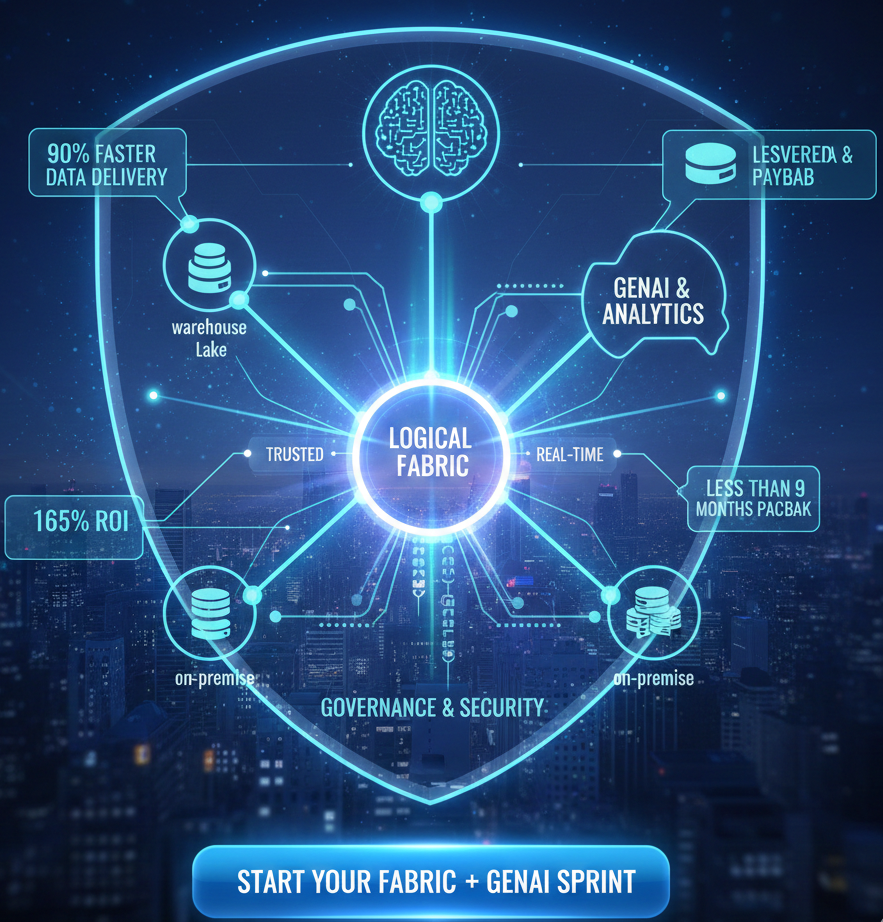
A Logical Data Fabric is not another data platform. It is an intelligence layer that sits above your existing systems.
It allows enterprises to:
- Access data where it lives
- Apply consistent business meaning
- Enforce governance in real time
- Serve analytics, applications, and AI from a single logical view
At its core, LDF combines data virtualization, semantic modeling, metadata intelligence, and federated security into one architecture.
Think of it as Google Search for enterprise data — but governed, explainable, and secure.
Core Capabilities of Logical Data Fabric
- Data Virtualization — Query across sources without copying data
- Semantic Layer — Centralized definitions, KPIs, and business logic
- Active Metadata — Intelligence about data relationships and usage
- Federated Security — Policies enforced at query time
- Multi-Platform Support — Works across cloud, on-prem, and SaaS
Reference :
Denodo — Logical Data Fabric Overview https://www.denodo.com/en/products/data-fabric
GENAI + LOGICAL DATA FABRIC: THE MISSING ARCHITECTURE FOR ENTERPRISE AI
GenAI does not fail because of weak models. It fails because of uncontrolled and untrusted data access. When Logical Data Fabric Powers Retrieval-Augmented Generation (RAG), GenAI becomes enterprise-ready.
Why Governed RAG Changes Everything :
- Accuracy improves because the semantic layer provides approved definitions, relationships, and calculations.
“Revenue” now means the same thing everywhere — across dashboards, reports, and AI responses. - Real-time intelligence emerges because data is queried live from source systems. AI agents see current inventory, pricing, and operational states — not last week’s snapshot.
- Security is enforced by design. With platforms like IBM Watsonx.Governance, access controls, masking, and lineage are applied before data ever reaches the LLM.
- Accuracy improves because the semantic layer provides approved definitions, relationships, and calculations.
The result is GenAI that is:
- Trustworthy
- Auditable
- Secure
- Business-aligned
References :
IBM — Watsonx.Governance https://www.ibm.com/products/watsonx-governance
THE BUSINESS CASE: TURNING DATA DEBT INTO DIGITAL EQUITY
For CFOs and CIOs, Logical Data Fabric is not an architectural luxury.
It is an economic correction.
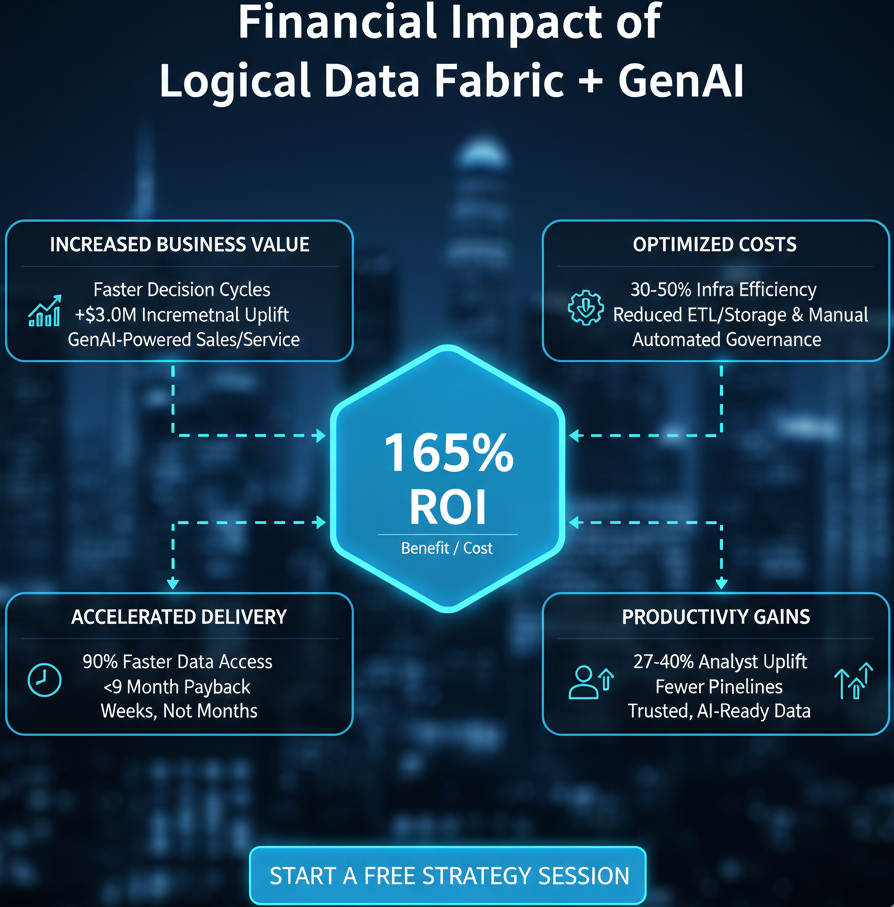
- Productivity Impact
Traditional BI and analytics initiatives typically deliver 10–15% productivity improvement.
Organizations using Logical Data Fabric consistently achieve 25–40% gains, driven by:
- Faster data access
- Fewer data preparation steps
- Reduced dependency on engineering teams
- Infrastructure Economics
By reducing data duplication, enterprises lower:
- Storage consumption
- Cloud compute usage
- Data pipeline complexity
- Governance overhead
- Typical 12-Month Impact for a $3B Enterprise
- $2.3M in cost avoidance
- $3.0M EBIT uplift
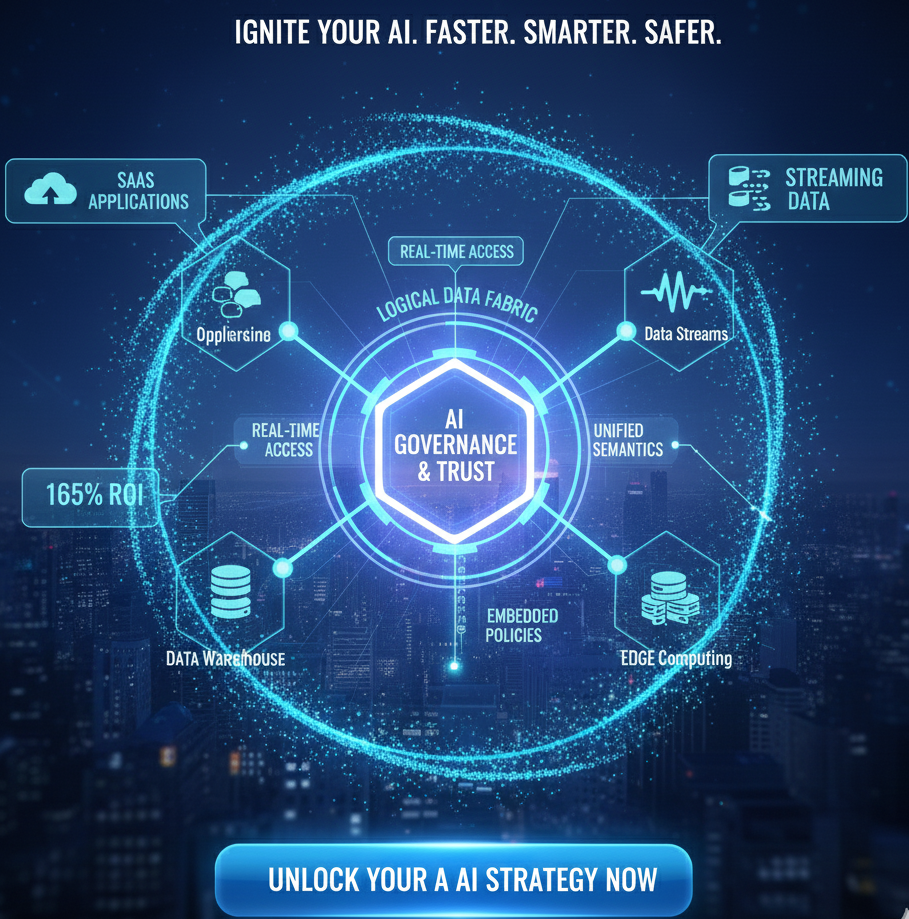
- 165% ROI
- Payback in under 9 months
LOGICAL DATA FABRIC WORKS WITH WHAT YOU ALREADY HAVE
Logical Data Fabric is an augmentation strategy, not a rip-and-replace initiative.
It works seamlessly across modern platforms:
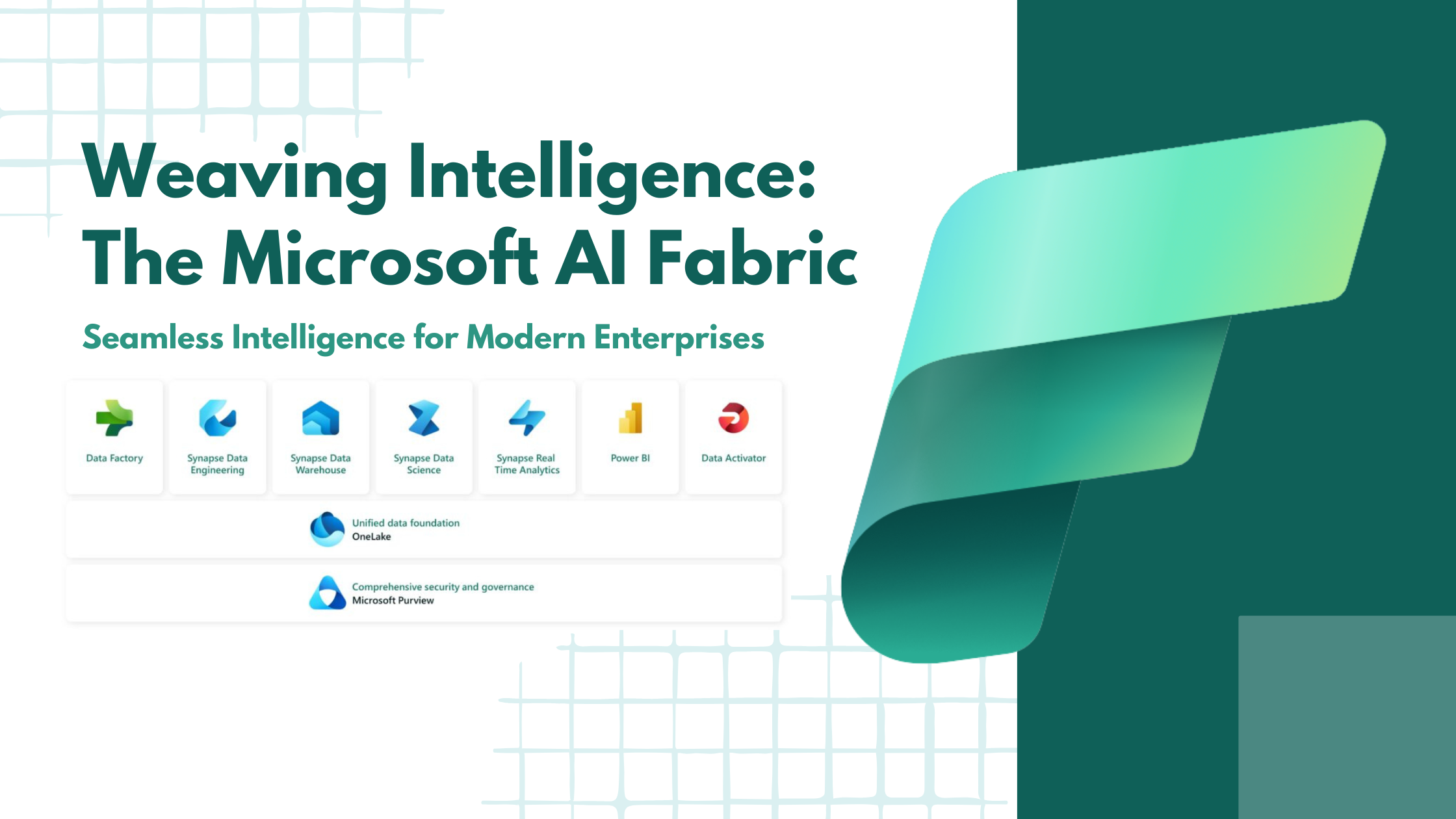
- Microsoft Fabric — Extends semantics beyond Azure https://learn.microsoft.com/en-us/fabric/
- Databricks — Reduces unnecessary Spark jobs for BI and AI
https://www.databricks.com/ - Snowflake — Controls warehouse sprawl and runaway consumption
https://www.snowflake.com/
Your investments stay intact. Your data becomes usable.
THE CRESCO APPROACH: FAST, FOCUSED, OUTCOME-DRIVEN
At Cresco International, we do not run multi-year theoretical programs.
Our delivery model is pragmatic and value-led:
- Value Framing — Identify the AI or analytics bottleneck blocking outcomes
- Semantic Foundation — Deploy a Denodo-powered logical layer
- GenAI Enablement — Connect governed RAG to real workflows
- Enterprise Scale — Automate governance and expand adoption
The focus is always measurable business value — fast.
CONCLUSION: ARCHITECTURE IS STRATEGY
In 2025, AI success is not determined by who has the biggest model.
It is determined by who has the cleanest, fastest, and most trusted access to data.
Enterprises that continue to rely on heavy data movement will struggle with cost, latency, and governance.
Enterprises that adopt Logical Data Fabric will unlock real-time intelligence, trustworthy GenAI, and sustainable AI economics.
Logical Data Fabric is no longer optional.
It is the operating system for AI-first enterprises.
CALL TO ACTION: PROVE IT IN 21 DAYS
If you want to move beyond AI pilots and dashboards — and actually operationalize GenAI with trust — the fastest way is to see it work in your own environment.
The Cresco 21-Day LDF + GenAI Value Sprint
In just 21 days, we help you:
- Build a live semantic layer across critical data sources
- Enable governed GenAI answers on real business data
- Quantify ROI with a clear executive roadmap
- Decide confidently whether to scale enterprise-wide
Learn more or start the conversation: https://www.crescointl.com