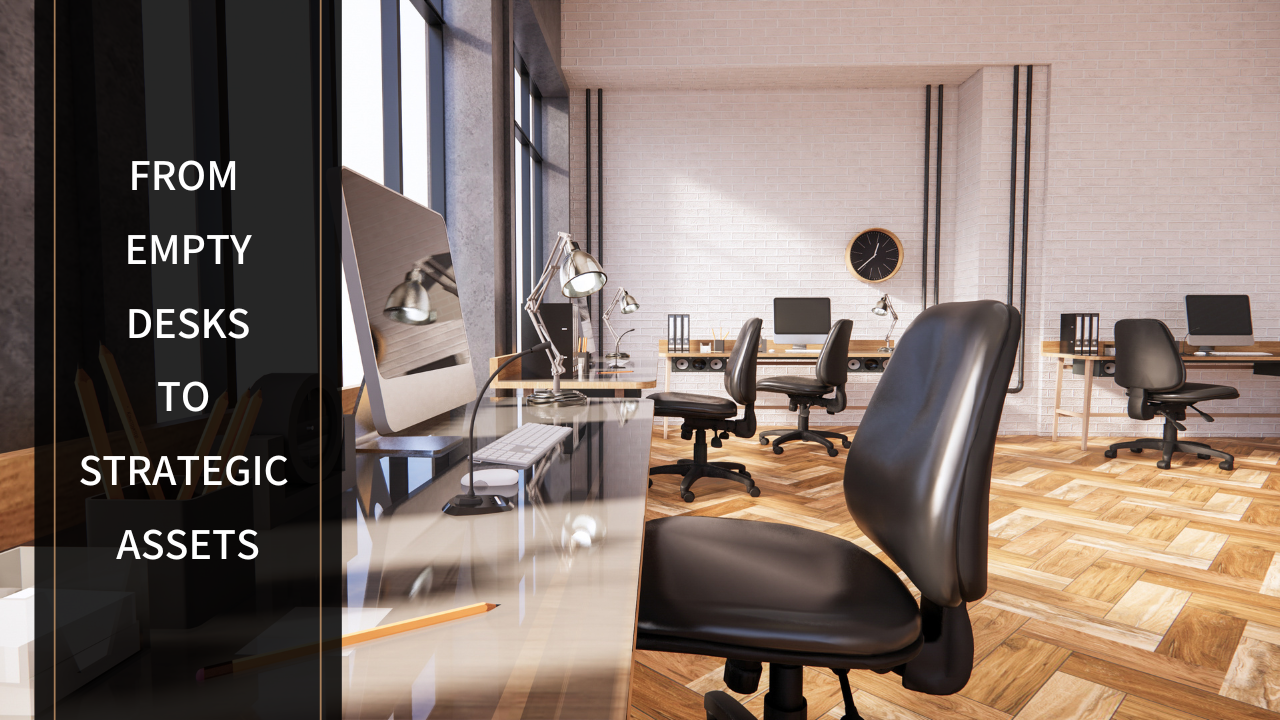

In boardrooms across global enterprises, underutilized offices have become an uncomfortable paradox.
- Leaders pay for premium real estate, yet walk through half-empty floors.
- Teams say collaboration matters, yet calendars remain packed with virtual meetings.
- CEOs want speed and culture, while employees want flexibility and autonomy.
This isn’t a “return-to-office” debate.
It’s a capital allocation and operating model problem—with direct implications for margins, resilience, talent, risk, and growth.
Most office footprints were designed for a world that assumed predictable attendance, stable roles, and linear growth. That world no longer exists. Hybrid work is not a phase; it is a structural shift in how value is created, coordinated, and retained.
When leaders treat low attendance as a Behavioral issue to correct, they miss the real problem:
Work has changed faster than the workplace—and faster than most operating models can adapt.
The result is a silent drain on performance and cash:
- Committed leases,
- Underused assets,
- Inconsistent policies,
- Fragmented data,
- And a widening gap between the workplace leaders intend and the one employee’s experience.
This blog reframes underutilized offices as a solvable strategic challenge—one that requires disciplined hybrid work operating model design, workforce planning, and real estate portfolio optimization, supported by space utilization analytics and strong governance.
The objective is not to force attendance—but to make the workplace earn its place in the operating model.
WHY UNDERUTILIZATION PERSISTS AND WHY IT’S COSTLY
The root causes are structural, not Behavioral
Most organizations didn’t choose underutilized offices; they inherited them. Common drivers include:
- Work has decoupled from place
Outcomes can now be delivered from multiple locations, and the need for co-location varies by role, function, and project phase. - Policies misaligned with workflows
Many hybrid policies mandate days in office without clarifying why—or what outcomes are better together. - Volatile and uneven demand
Attendance fluctuates by season, business cycle, leadership behavior, and commute realities. Averages hide peaks and bottlenecks. - Legacy footprint assumptions
Long leases, “one seat per employee” thinking, and static space standards don’t match dynamic capacity needs. - Fragmented data
Facilities, HR, IT usage, and business outcomes are rarely integrated—making informed decisions difficult. - Conflicting incentives
CFOs chase efficiency, COOs want predictability, CIOs prioritize secure productivity, CHROs focus on engagement. Without a unifying model, decisions stall.
THE REAL COST—BEYOND THE P&L
Underutilized offices create compounding impact across the enterprise.
Financial
- Fixed lease and facilities costs persist regardless of use
- Capex and fit-out investments become harder to justify
- Poorly designed space quietly increases cost per output
Operational
- Friction in finding rooms, reliable tech, and clear norms
- Unpredictable attendance complicates cross-functional execution
- Support services staffed for capacity, not demand
People & Talent
- Perceived unfairness across roles and locations
- Commuting without purpose increases attrition risk
- Culture becomes accidental, not designed
Competitive
- Slower decision-making and collaboration cycles
- Reduced agility for scaling, launches, and integrations
- Missed opportunity to use the workplace as an innovation lever
What happens if leaders do nothing
“Wait and see” almost always leads to:
- Repeated policy swings and trust erosion
- Real estate decisions driven by lease deadlines, not strategy
- Shadow booking and attendance systems
- A workplace that is expensive, underused, and misaligned with priorities
WHAT HAS FUNDAMENTALLY CHANGED
- Hybrid is not a policy, it’s an operating system
A hybrid work operating model defines:
- How work is planned and allocated,
- How teams collaborate and decide,
- How performance is measured,
- How technology enables delivery,
- And how the workplace supports outcomes.
Mandates and averages fail because they treat hybrid as compliance—not productivity architecture.
2. Utilization is a lagging indicator, not the goal
High occupancy without purpose creates the wrong behaviours:
- People Come in to Be Seen,
- Meetings Stay Virtual Anyway,
- The Office Becomes a Time Tax.
The right starting question is:
Which work is meaningfully better together—and how do we design for it?
- The workplace must flex like the business
Enterprises now face rapid shifts in:
- Product cycles,
- Regulatory pressure,
- Ai-driven role redesign,
- Global talent and GCC strategies.
Real estate remains rigid. That mismatch is the root of chronic underutilization.

THE SPACE EXECUTION FRAMEWORK
A practical, low-disruption model to move from underutilized offices to fit-for-purpose workplaces.
S — Segment work by collaboration value
- Identify work that is better together
- Identify work that is location-agnostic
- Define role-based patterns—not blanket rules
Fairness feels good. Segmentation works better.
P — Anchor portfolio decisions in business strategy
- Classify sites: collaboration hubs, delivery centers, client-facing, specialized, satellite
- Use lease events strategically: resize, repurpose, consolidate, exit
- Build flex capacity instead of overcommitting
A — Use analytics leaders trust (and employees accept)
- Combine booking, room usage, Wi-Fi density, access patterns
- Focus on patterns—not surveillance
- Link utilization to outcomes like cycle time and onboarding effectiveness
C — Design collaboration-ready workplaces
- Fewer unused desks, more activity-based zones
- Reliable, standardized meeting-room tech
- Anchor days and moments designed for outcomes—not optics
E — Establish enterprise governance
- Cross-functional ownership (HR, IT, Finance, Real Estate, Business)
- One accountable executive sponsor
- Metrics tied to value—not just occupancy
A PRACTICAL 30–60–90 DAY ROADMAP
Days 1–30: Diagnose
- Map footprint, leases, and cost baseline (USD)
- Segment roles by collaboration value
- Identify friction points
- Set governance and decision cadence
Days 31–60: Pilot
- Run privacy-first analytics in 1–2 sites
- Prototype collaboration zones
- Develop portfolio scenarios
- Align manager expectations
Days 61–90: Execute
- Make 1–2 high-confidence portfolio moves
- Standardize meeting technology
- Scale role-based hybrid norms
- Launch outcome-led dashboards
HOW CRESCO INTERNATIONAL ENABLES THIS—WITHOUT DISRUPTION
Cresco International helps organizations move from debate to execution by:
- Bridging strategy and operating model design
- Operationalizing real estate portfolio optimization
- Enabling pragmatic, ethical space utilization analytics
- Supporting GCC footprint and scalability decisions
- Executing in phases to protect continuity
The goal is simple:
Reduce waste, improve collaboration effectiveness, and ensure the workplace earns its place in the operating model.

EXECUTIVE TAKEAWAYS
- Underutilized offices signal operating model misalignment—not discipline failure
- Utilization is not the objective—value is
- Segment work by collaboration value
- Use analytics ethically to improve decisions
- Treat workplace decisions as strategic capital allocation
CONCLUSION: THE REAL OPPORTUNITY
The challenge of underutilized offices reflects a deeper shift in how organizations create value.
The winners won’t be those forcing old norms—or abandoning offices entirely.
They will be the ones making the workplace purposeful: designed, measured, and governed like any critical enterprise capability.
The goal isn’t to fill seats. It’s to ensure every dollar spent on space, services, technology, and time delivers business value.
That’s how underutilized offices become strategic assets.
Get in Touch
If your organization is reassessing underutilized offices, hybrid norms, or global portfolio decisions, Cresco International can help you move from ambiguity to disciplined execution, without disruption.
A focused conversation can quickly clarify:
What to change, What to keep, And how to move forward with confidence.
Let’s Tak