
What’s changed this quarter (and why leaders feel it)
If your leadership team feels like the ground shifted again this quarter, you’re not imagining it.
Across boardrooms, the conversation has moved from “How do we transform?” to “How do we stop transformation from becoming a permanent cost center?”—at the same time margins are tightening, risk expectations are rising, and technology is advancing faster than operating models can absorb.
[accenture.com], [mckinsey.com], [sec.gov]
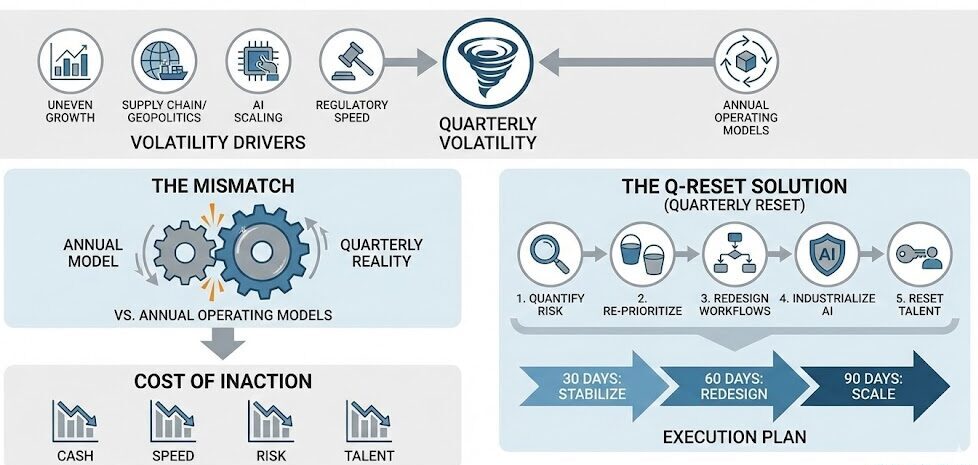
This quarter feels sharper because multiple forces are colliding at once:
- Uneven growth and affordability pressure
- Supply-chain re-routing driven by geopolitics
- AI scaling faster than governance and workflows
- Regulatory scrutiny demanding faster, defensible decisions
The stakes are concrete. When execution drifts, the business pays in four currencies:
- Cash (cost leakage, working capital drag)
- Speed (slower time-to-market)
- Risk (compliance, cyber, resilience gaps)
- Talent (burnout, attrition, stalled capability building)
And the longer organizations wait, the harder recovery becomes—because complexity compounds quietly.
THE CORE PROBLEM THIS QUARTER: OPERATING MODELS LAG QUARTERLY REALITY
What’s actually broken?
Across manufacturing, BFSI, retail, logistics, IT services, healthcare, and pharma, leaders are facing the same structural issue:
The environment is changing on a quarterly cadence, but organizations are still designed to adapt annually.
This mismatch shows up predictably:
- Transformation fatigue & diluted ownership
Too many initiatives, unclear decision rights, drifting outcomes. - Technology acceleration without workflow redesign
AI exists—but value remains local, not enterprise-wide. - Rising risk expectations without matching controls
Cyber disclosure, board accountability, and readiness gaps. - Supply-chain diversification treated as episodic, not systemic
Networks expand, but governance and planning rhythms don’t.
- Transformation fatigue & diluted ownership

WHY THIS IS HAPPENING NOW?
- Fragmentation is now structural
Geopolitics and policy shifts keep reshaping value chains. Resilience is no longer optional—it’s a design requirement.
- AI has moved from pilots to production pressure
Interest in agentic and enterprise AI is rising, but governance maturity is lagging, creating operational and reputational exposure.
- Talent expectations have shifted
Especially across India and GCC ecosystems, organizations are being asked what they can own, not just what they can execute—raising the bar on leadership capability.
THE COMPOUNDING COST OF “DO NOTHING”
When operating cadence isn’t reset, four outcomes follow:
- Financial drag: spend increases without bending cost curves
- Operational fragility: cycle times lengthen, variance breaks systems
- People risk: high performers burn out managing ambiguity
- Competitive loss: peers industrialize AI while others stay stuck piloting
WHAT’S CHANGED THIS QUARTER: THREE EXECUTIVE-LEVEL SHIFTS
- The quarter is now the unit of advantage
Annual plans can’t keep up with quarterly volatility. Leaders must sequence investments tightly and govern harder—not slower.
- Supply chains are stable—but not safe
Diversification improves resilience but raises coordination costs. Without redesigned governance, quality and OTIF suffer.
- AI is now an operating-system problem
The question is no longer “Which use cases?” . It’s “Which workflows, controls, roles, and failure modes?”
WHY TRADITIONAL APPROACHES NO LONGER WORK
Three failure patterns repeat:
- Annual planning vs quarterly reality
- Technology without operating-model change
- Governance that tracks activity, not outcomes
A PRACTICAL RESPONSE: THE Q-RESET MODEL
Quarterly Reset for Execution & Transformation
A repeatable way to answer “What’s changed this quarter?” without creating bureaucracy.
Move 1: Quantify value at risk
Define the 3–5 outcomes that cannot fail this quarter and quantify downside if execution slips.
Move 2: Re-prioritize ruthlessly
Shift from too many initiatives to three clear buckets:
- Protect
- Perform
- Position
Cut low-value concurrency—not strategic bets.
Move 3: Redesign 2–3 critical workflows
End-to-end ownership. Fewer handoffs. Automation and controls built in.
Move 4: Industrialize AI with guardrails
AI as production capability—not experimentation:
- Governance
- Embedded workflows
- Defined escalation paths
Move 5: Reset talent for ownership
Move from capacity to accountability—product, platform, and process ownership.
30–60–90 DAYS: WHAT LEADERS SHOULD ACTUALLY DO</H3
First 30 days — Stabilize
- Identify value-at-risk outcomes
- Stop low-value work
- Assign single accountable owners
Days 31–60 — Redesign
- Rebuild priority workflows
- Define AI governance
- Instrument outcome-based scorecards
Days 61–90 — Scale
- Lock governance and RACI
- Move AI from pilot to production
- Reset talent and capability plans
HOW CRESCO INTERNATIONAL ENABLES THIS SHIFT
Cresco International supports organizations by connecting strategy to operating reality—without adding layers.
- Execution-led transformation
- Speed-to-value diagnostics and sprints
- GCC and shared-services ownership models
- Finance and process optimization
- Flexible engagement models
The goal is simple: make quarterly priorities executable.
EXECUTIVE TAKEAWAYS
- Quarterly volatility + annual operating models = compounding drag
- Resilience requires operating redesign, not just diversification
- AI advantage comes from workflows and governance, not pilots
- Risk expectations penalize slow decisions
- Winning leaders institutionalize a quarterly reset
CONCLUSION: THE NEW DISCIPLINE OF LEADERSHIP
“What’s changed this quarter” is no longer a discussion point—it’s a management system.
The winners won’t be those with the most initiatives.
They’ll be the ones with repeatable execution at quarter speed.
CTA: INVITATION TO ENGAGE
If you’re reassessing priorities this quarter—margin protection, GCC evolution, AI scaling, or operating-model alignment—Cresco International can help convert urgency into a focused 30–60–90 plan with clear ownership and measurable outcomes.
Start the conversation. Make this quarter executable.